


Brought to you by ExecReps.ai, AI-powered executive presence coaching for teams.
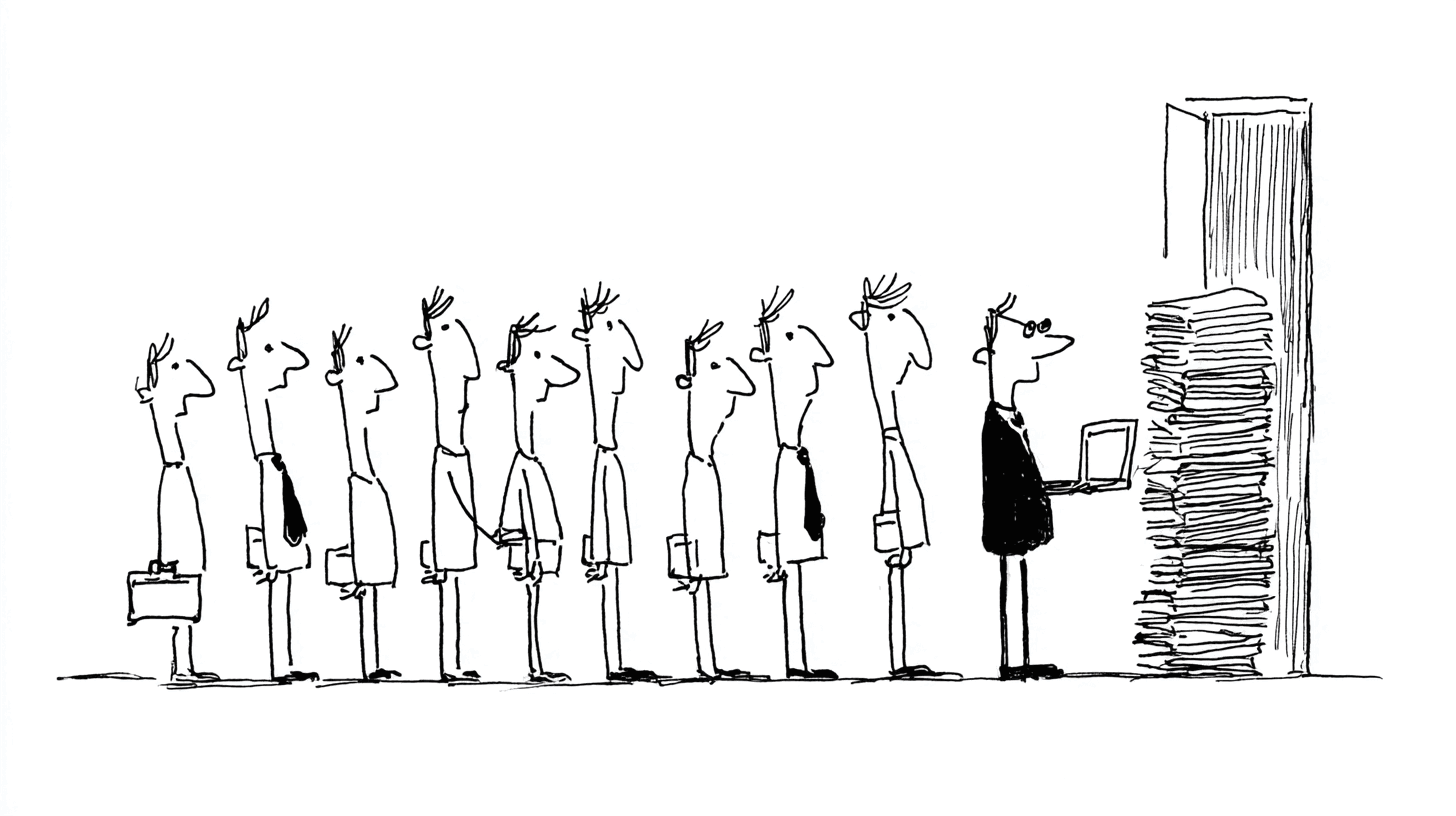
I have run stand-ups that were status reports with better posture. Fifteen minutes, nine people, one manager writing it all down. Everybody left feeling busy and nobody left knowing anything new.
The ceremony was not the problem. What we wanted from it was the problem, and what we wanted was the feeling that the quarter was under control.
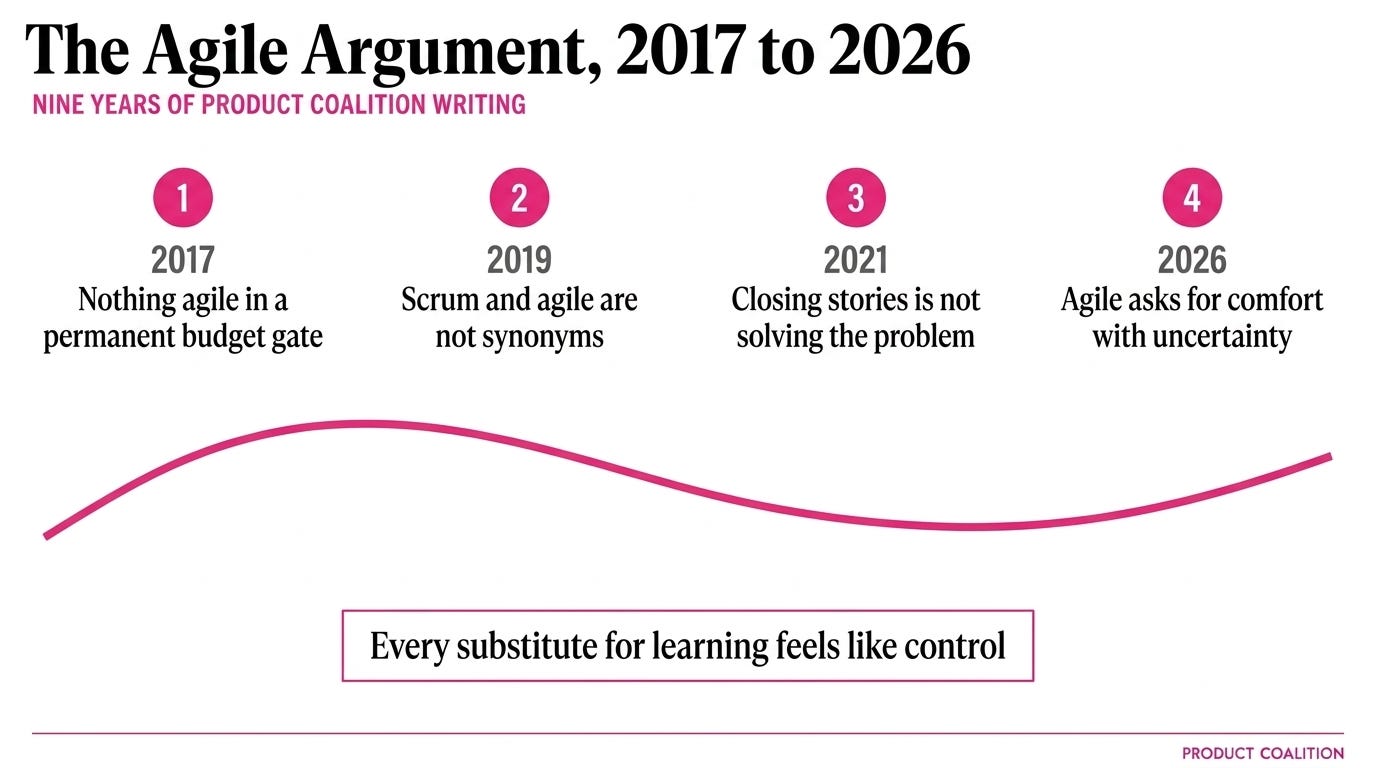
I traced a piece of this argument in May, when user stories turned from a conversation into a compliance document. That was one artefact. This week I want the operating model around it, because the archive has been picking the same fight since 2017.
"If a team waits until the feature is complete before gathering customer feedback, the team is pretending to be agile." Joe Van Os, writing in Product Coalition
In 2017 the Threat Was the Budget Meeting
Product Coalition is twelve years old, so I can read what practitioners believed at the time rather than what the conference circuit remembers.
Stefan Wolpers published a catalogue of agile management anti-patterns in September 2017. The one he leads with is not a badly run retrospective. It is the finance calendar. "The budgeting process is hard to align with agile requirements like the longevity of teams."
He then names the behaviour rather than the process. "It is a sign of mistrust, though, if the management uses the budget permanently as a means of controlling the teams, making them 'pitch' every two months or so. There is absolutely nothing 'agile' to be found in this practice."
Notice what he is not saying. He is not saying agile failed, and he is not saying the ceremonies are theatre. He is saying the old control mechanism survived the transition and kept working, quietly, through the budget.
That is a nine-year-old warning about something I watched happen last year. A team with full autonomy inside the sprint, and none at all over what it was allowed to be working on by March.
Joe Van Os made the practitioner's version of the point nine months later. "Most teams seem to be transitioning to operating in a scrum format: releasing in sprint cycles, and claiming that this alone is making them agile." He read that as a mini waterfall with Scrum meetings bolted on, and he was writing about the teams around him rather than a survey.
By 2021 the Ritual Had Become the Progress Report
The next move in the archive is more specific, and it costs the writer something to make.
Martin Michalik explained in November 2021 why his company stopped running two-week sprints. His diagnosis is one line long. "The focus is often on closing stories, not solving the problem."
Read the rest of that piece and it is not an exit from agile. He keeps the principles, drops the fortnightly cadence, and replaces it with goal-led build and refine cycles. The thing he removed was the container, not the belief.
Van Os had already drawn the line the argument needs. Writing in March 2019, he gave a section the title "Scrum and Agile are Not Synonyms", warned against defining success by velocity and volume, and said the rest of the business has to share the principles for any of it to hold.
Stefan Wolpers came back to the subject in August 2020 with the coach's view of the same decade. "Scrum Masters and agile coaches are close to either burnout or indifference. Product Owners who 'own' the product by name only, and developers questioning why 'Agile' is imposed upon them and often turns out to be just another form of micromanagement."
That is one coach describing what he sees, not a measurement of the industry, and I am not going to inflate it into one. What it does show is the vocabulary of agile sitting comfortably on top of command and control.
Four writers, three years apart, all circling the same substitution. A cadence that was meant to shorten the distance to a customer becomes the way the organisation reports on itself. I have sat on both ends of that. As a VP I asked for the sprint review because it was the cheapest window I had into nine teams, and I told myself I was there to unblock them.
Nobody in that room was fooled.
In 2026 the Argument Moved Underneath the Process
The recent archive stops arguing about frameworks, which is the part I did not expect to find.
Marc Brickley published in February this year and put the obstacle somewhere no framework can reach. "Agile does not fail because teams resist change. It fails because it demands a psychological comfort with uncertainty that not everyone has."
He is explicit that the public debate is still stuck on frameworks, ceremonies and process. His claim is that working in short loops asks people to act before they know, repeatedly, in front of colleagues.
Put that next to Wolpers in 2017 and the two-month pitch stops looking like bad governance. It looks like a request for relief. If the quarter has to be re-justified every eight weeks, at least somebody feels informed, and feeling informed is not nothing when you are accountable for a number you cannot personally influence.
Brickley's framing also explains why the ceremonies are the last thing to go. They are the visible, schedulable part of a practice whose real demand is invisible. You can put a retrospective in a calendar. You cannot put "tolerate not knowing until Thursday" in a calendar.
Jonathan Essary is worth keeping in the frame, because he refuses the obituary. He was writing in August 2022 against the idea that agile is dead. "Agile methods are often taught as fixed steps to follow, but in practice, it requires a dynamic approach to ensure people and products effectively move forward."
So the archive is not post-agile and never was.
Nine years of it keep testing practices against one question, which is whether the team is learning faster than it is committing.
What I'm Hearing on the Podcast
Dave West runs Scrum.org and has been on the podcast twice. The first time, in February last year, a good stretch of it went to the CFO, which is where Wolpers' budget gate lives.
He described the annual planning round from the finance side of the table. "We have all these strategic initiatives. We then say to the organization, how much would it cost to deliver these? We then barter a bit because, you know, it's always more than we can afford. And we then draw a line and then we draw another line."
He told the finance people at a New York conference what funding products instead would remove, and got a reaction I recognised. "And they said, well, so we would not have that anymore. So how do we ensure that money is being well spent? And I said, well, you have to trust your teams. They said, what?"
He puts the upside with the finance function rather than the teams. He wants to "free up finance to be less about basically control and more about opportunity."
Wolpers called that gate mistrust in 2017. Seven years on, the man who runs Scrum.org is describing the way out of it to the people who own it. Their first question is how they would know the money was well spent.
Dave also left me a test I keep using. "The question is, if it's a complex problem, are you incrementally delivering learning against that problem, thus refining your understanding of it and delivering more value?"
Nothing in that sentence is about a framework.
It asks whether the learning is arriving, which is the only thing a stand-up can honestly report.
Andrew Hobday spent years running enterprise agility inside a large insurer before writing about the psychology underneath it. I asked him what he had seen go wrong in transformations.
"Then it had snapped back like a cheeky little piece of elastic to almost where it was before, after spending so much time and effort on it and money."
He separates the two things that get sold as one. "I think of enterprise agility like mechanics or the cogs of agility. So things like quarterly planning and connecting strategy to execution. Whereas business agility is this human factor, it's this human element that kind of sits over that system of cogs."
His name for buying the first and calling it the second is the "superficial sheep dip", where everyone attends the course, collects the certificate, and the organisation declares itself agile.
Andrew's warning is about what happens after the coaches leave. "As soon as we get the people on the bus driving somewhere, they take the Uber back as soon as they can."
So What Does This Mean for You?
Stop auditing your ceremonies. Pick the last three decisions your team reversed, and ask how long each one took to reverse.
That number is the only agility measure I trust, because it cannot be performed.
A team with immaculate ceremonies and a six-month reversal time is not agile, whatever the wall of sticky notes says.
Then look for the thing Wolpers found in 2017. It has been present in every organisation I have worked inside, including the ones that had finished their transformation.
Find the gate where somebody re-justifies work that was already agreed, and ask what it is protecting against. In my experience it is protecting a senior person from the discomfort of not knowing.
Nine years of the archive point at something quieter than a manifesto. Every substitute for learning feels like control, which is exactly why teams keep reaching for it.
So think about your last planning session. Was anybody in that room made less certain by it, and what happened to them when they said so?
Got a product story worth telling? Whether you're an exceptional talent shaping the future of product, or you've got a career journey others can learn from, I want to hear from you. Apply to be a guest on the Product Coalition podcast.
👋 Jay
Product Coalition is a reader-supported publication. Paid subscribers get every issue on the day it lands.