


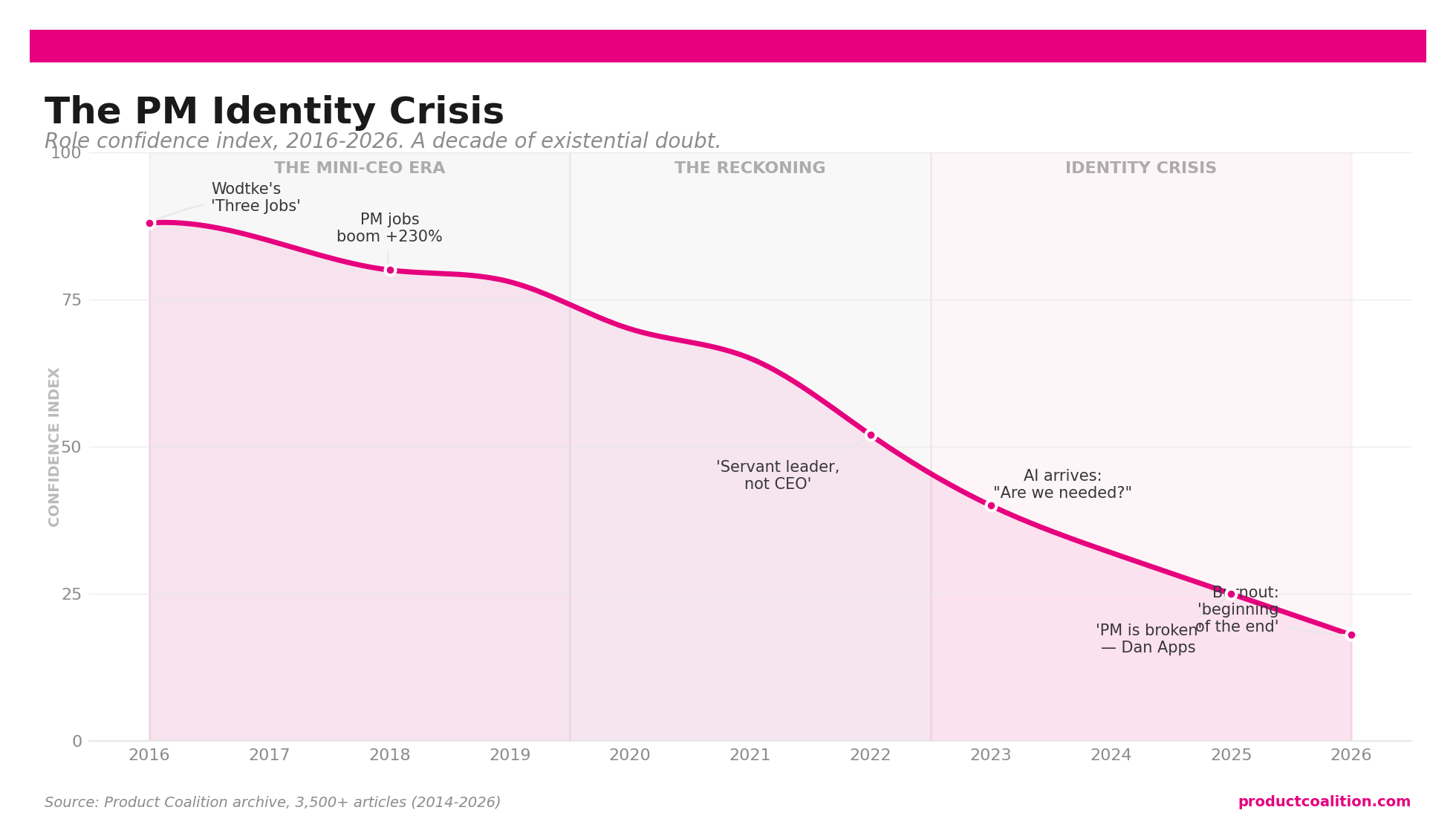
In 2016, the PM job felt clean. Three jobs, one framework, minimal existential dread. Ten years later, a PM writes about burnout so deep that “just take a break” feels like a joke. Somewhere between those two moments, an entire profession lost the plot on what it was supposed to be.
I spent the last week reading through a decade of Product Coalition articles about the PM role. What I found is less a career arc and more an identity crisis playing out in slow motion.
Brought to you by ExecReps, AI-powered executive coaching for product leaders
“Three Jobs, Not Enough Time” (2016)
Christina Wodtke wrote The Three Jobs of Product Management back in 2016, and it still reads like the clearest thing anyone has said about the role. Business Owner. Vision Holder. Team Coordinator. That’s it.
But Christina also flagged something most people glossed over. “A Product Manager often has influence without authority,” she wrote. “She can’t fire anyone, or even get them off her team.” Think about that for a second. We spent years calling ourselves mini-CEOs when we couldn’t even choose who sat at our own table.
She also nailed something about the daily reality: “Product Managers, like all humans, tend to do the work that has the most screaming associated with it.” If you’ve ever abandoned your roadmap to fix a billing escalation, you know exactly what she meant.
“The Title I Prefer Is Servant Leader” (2022)
John McDonald didn’t tiptoe around it. His 2022 piece Why Acting Like the “CEO” of Your Product Might Be Doing More Harm Than Good went straight at the Horowitz memo that started it all. “Many a product managers use this line as a justification for their behavior,” he wrote. And honestly? I’ve seen it happen.
His replacement? “The title I prefer is ‘servant leader’. I get it, it’s not as sexy as ‘CEO’, but I think it’s a lot more evocative and representative of the role.”
Meanwhile, something awkward was happening. PM jobs had grown 230% between 2017 and 2022. But Kasey Fu confessed in The Hidden Value a PM Brings to the Product Team that engineers were still asking the uncomfortable question: “What value do you folks even bring?”
That line still makes me wince. Not because it’s unfair, but because most PMs, if they’re honest, have struggled to answer it clearly.
“Wait, Are We Even Needed?” (2023-2026)
Then AI walked into the room. Jing Hu put it bluntly in No Such Thing As An AI Product Manager: all product managers now have to swim in the AI pool. There’s no special “AI PM” title. There’s just PM, with a whole new set of capabilities to understand.
What fascinates me about Jing’s piece is the diagnosis underneath. PMs had become “button placers, conversion makers, document writers” for so long that bold technology actually felt unfamiliar. AI didn’t threaten the PM role. It exposed how small the role had become.
Then Dan Apps published the title that stopped the scroll. Product Management Is Broken: This Is Where It Ends. After 16 years in the field, Dan wrote that he’d been “quietly haunted by the same dysfunction” across every company. His verdict: “Product Managers need to stop internalising blame for a system that’s broken by design.”
And in early 2026, Irina Bulygina made it personal. I’m Burned Out and “Just Take a Break” Is Not Helping reads less like an article and more like a late-night conversation with a friend. “I sit on both sides of the barricades,” Irina wrote, “trying to understand everyone at the same time.”
This is the part that gets me. She’s not questioning the strategy frameworks or the org chart. She’s questioning whether the emotional cost of the job is sustainable. “Fear that AI is replacing us. Fear that the product manager role is becoming obsolete. Fear that we are watching the beginning of the end.”
What I’m Hearing on the Podcast
This tension showed up on the Product Coalition podcast too. In EP98, Margaret-Ann Seger argued that the best product ideas shouldn’t come from product managers at all. That’s the servant leader thesis taken to its logical conclusion: your job isn’t to have the ideas, it’s to create the conditions where good ideas surface from anywhere.
Brian Glassman explored the other side of the coin in EP81, making the case that generative AI can actually free PMs from the button-placing and document-writing that Jing described, letting them get back to the bold thinking the role was always meant for.
So What Does This Mean for You?
Here’s what I keep coming back to. The PM role has survived every identity crisis of the past decade. Mini-CEO, servant leader, empowered teams, AI disruption, burnout. It survives because the need for someone to hold the thread between business, technology, and users never goes away. The title changes. The job description changes. The core need stays.
So try this at your next dinner party. Someone asks what you do. You can’t say “product manager.” What comes out instead? I genuinely want to know. Hit reply and tell me.
You’re reading the Product Coalition newsletter. Every week, I dig into the archive of 3,500+ articles and 100+ podcast episodes to trace how product thinking has evolved. If someone forwarded this to you, subscribe here so you don’t miss the next one.
Jay Stansell · Lisbon, Portugal · Product Coalition