


Retention used to mean a stamp card at your sandwich shop. Ten purchases, one free. Then it meant push notifications at 3pm on a Tuesday. Now it means building a product so tangled into someone’s daily work that cancelling feels like a small divorce. I’ve been reading through seven years of retention thinking in our archive, and the honest version is funnier and darker than anyone admits.
Brought to you by ExecReps — AI-powered executive coaching for product leaders. Product Coalition members get extended access.
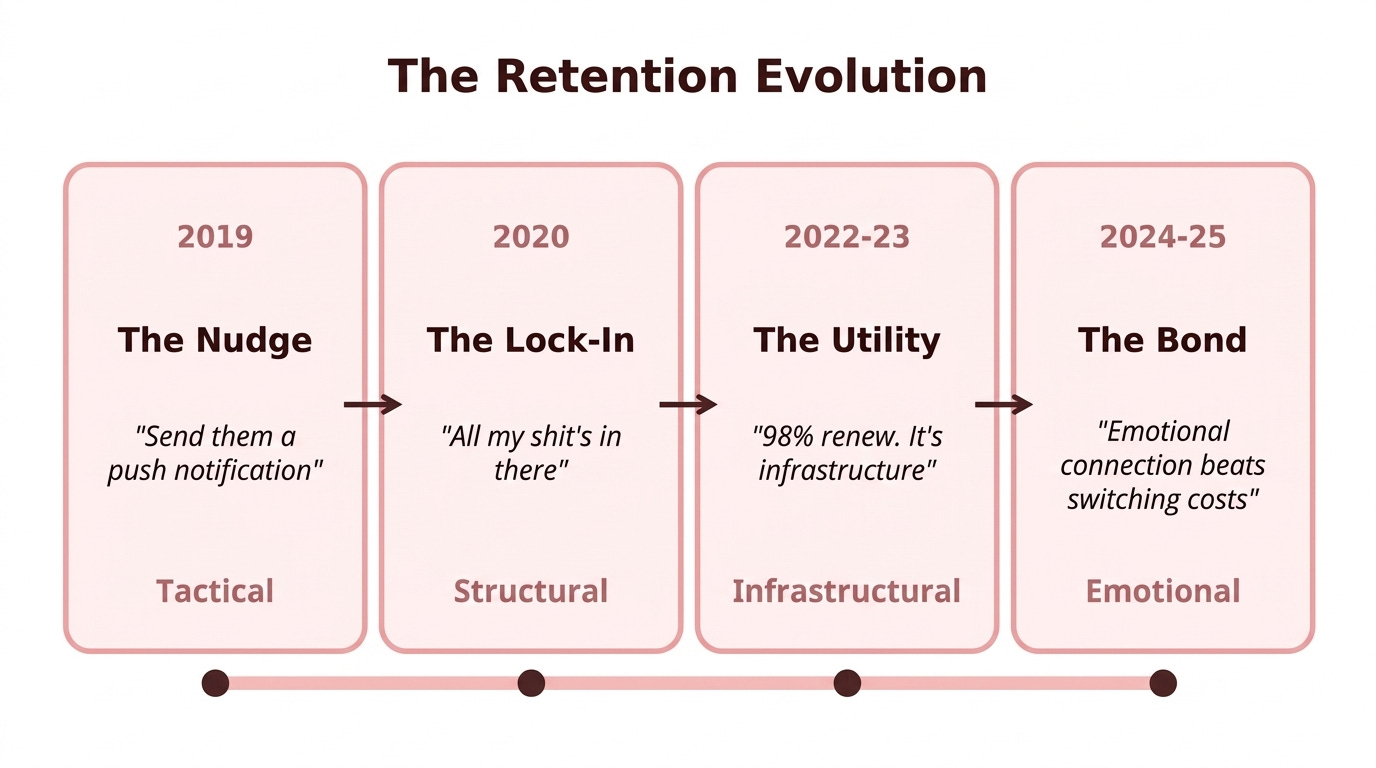
When ‘Ping Them Again’ Was the Plan (2019)
Before anyone was saying ‘product-led retention,’ the playbook was straightforward. A 2019 Product Coalition editorial on app retention laid out the accepted wisdom:
“A good onboarding experience can improve retention by up to 50%.”
The toolkit: onboarding flows, push notifications, personalization, re-engagement campaigns. Nudge the user. Remind them you exist. Hope they come back.
It wasn’t wrong. But it treated retention like a marketing problem. The question was always ‘how do we get them to open the app again?’ Nobody was asking ‘why did they close it?’
The Structural Turn (2018–2020)
The smarter thinking was already percolating. In 2018, Rob Finney wrote about network effects using the VHS vs Betamax story:
“What I had witnessed was a platform based network effect kicked off by a small advantage. The small advantage was then accentuated by a positive feedback loop.”
A system where more users equals more value equals less reason to leave. Retention was becoming structural, not tactical.
Then 2020 cracked things open. Carlos Gonzalez de Villaumbrosia named the shift to PLG: “It’s getting easier to build a business, but not easier to grow one.” When competitors replicate your features in six months, the product itself has to be the retention engine.
But my favorite retention concept in the entire archive came from Derek Skaletsky that same year. He’d built a search engine with genuinely excellent tech. Users kept churning after 90 days. His diagnosis was brutal: “Search is the most perishable activity on the web. You search for something, find your answer, and… close the tab.”
His conclusion? When users pour their data, workflows, and routines into your platform, switching feels like losing a part of yourself. He called this the ‘All My Shit’s In There’ factor. Still the most honest description of SaaS retention I’ve read.
The Number That Stops You Cold
That same year, Dennis Meisner pulled the Amazon Prime data:
“A stunning 93% of Amazon Prime members renew their subscription after the first year. After the second year, this number goes up to an incredible 98%!”
98%. By year two, Prime isn’t competing for your loyalty. It has become infrastructure. You don’t cancel your water bill. That’s the endgame of retention done right: you stop being a product and start being a utility.
From Tool to Infrastructure (2024–2025)
Lee Fischman wrote in 2024 about maintaining 90%+ B2B retention, and his framing was disarmingly simple: “The first reason our retention was so high was simply because customers needed our stuff. When they didn’t, they cancelled.”
No growth hacks. Just be so embedded in your customer’s context that removing you requires rewiring how they work.
Then Asher Atlas wrote in 2025 about a retention crisis when a music service lost its catalog overnight. His team’s reframe changed everything: “What if this isn’t a search problem? What if this is a discovery problem?” They turned a broken search into a trust-building experience. Retention, it turns out, lives in how you handle the moment when things go sideways.
What I’m Hearing on the Podcast
Nesrine Changuel (ex-Google, Spotify, Microsoft) came on the show and pushed this further. Her argument: “User loyalty is significantly enhanced by emotional connections.” The products people stay with longest are the ones they genuinely love, not just the ones they can’t figure out how to export their data from.
(Listen to EP82 with Nesrine Changuel)
So Where Does This Leave Us?
The arc is clear if you step back far enough. Retention went from ‘remind them you exist’ to ‘make leaving expensive’ to ‘make them not want to leave at all.’ I think most teams are still stuck in the ping-them-again era, measuring retention without asking what’s actually retaining people.
If your retention strategy starts with ‘how do we reduce churn,’ you might be asking the wrong question. The better one: why would someone choose to stay?
Reply and tell me where your team sits on this spectrum. I’m genuinely curious whether the AMSIT factor resonates, or if you’ve found something completely different keeping people around.
You’re reading the Product Coalition newsletter. Every week, I dig into the archive of 3,500+ articles and 100+ podcast episodes to trace how product thinking has evolved. If someone forwarded this to you, subscribe here so you don’t miss the next one.
Jay Stansell · Lisbon, Portugal · Product Coalition