


I remember the exact moment. It was late, past midnight, the kind of quiet where things come into focus. I was staring at the ExecReps website. Specifically, at our ‘Blog’ tab.
And I hated it.
Not the articles themselves. Oh no. We had thirteen of them. Deep dives into Bayesian Knowledge Tracing, spaced repetition science, the psychometrics behind our scoring system. Real substance. We’d spent weeks during v1.4 writing rigorous science communication pieces. They explained why ExecReps works, not just that it works.
There they sat. Under a tab labeled “Blog.”
Blog. The word itself felt like an apology. ‘Here’s our blog, where we publish stuff sometimes, mostly to appease the SEO gods.’ Every startup has a blog. Every startup’s blog is mostly ignored. The word has been so thoroughly colonized by low-effort content farms that it now signals the opposite of what it used to mean. It signals noise.
I pulled up Gong’s website. ‘Gong Labs.’ Google’s research division. ‘Google Labs.’
It clicked. This was a conceptual model problem. Don Norman’s work on design shows this. The words you use create mental models that shape every interaction that follows. ‘Blog’ triggers one set of expectations. Opinion pieces, SEO filler. ‘Lab’ triggers an entirely different model. Experiments, data, discoveries. Same content. Completely different user expectation.
That distinction changed everything.
The Content Marketing Graveyard
Most founders get content wrong. I did, too, for a while. We treat our blog as a marketing channel. Write posts. Target keywords. Sprinkle in CTAs. Hope Google sends traffic.
This model? It’s broken.
AI-generated content has flooded the internet. Every B2B SaaS blog reads like it was written by the same middle-management chatbot. ‘In today’s fast-paced business environment…’ You’ve already stopped reading, haven’t you?
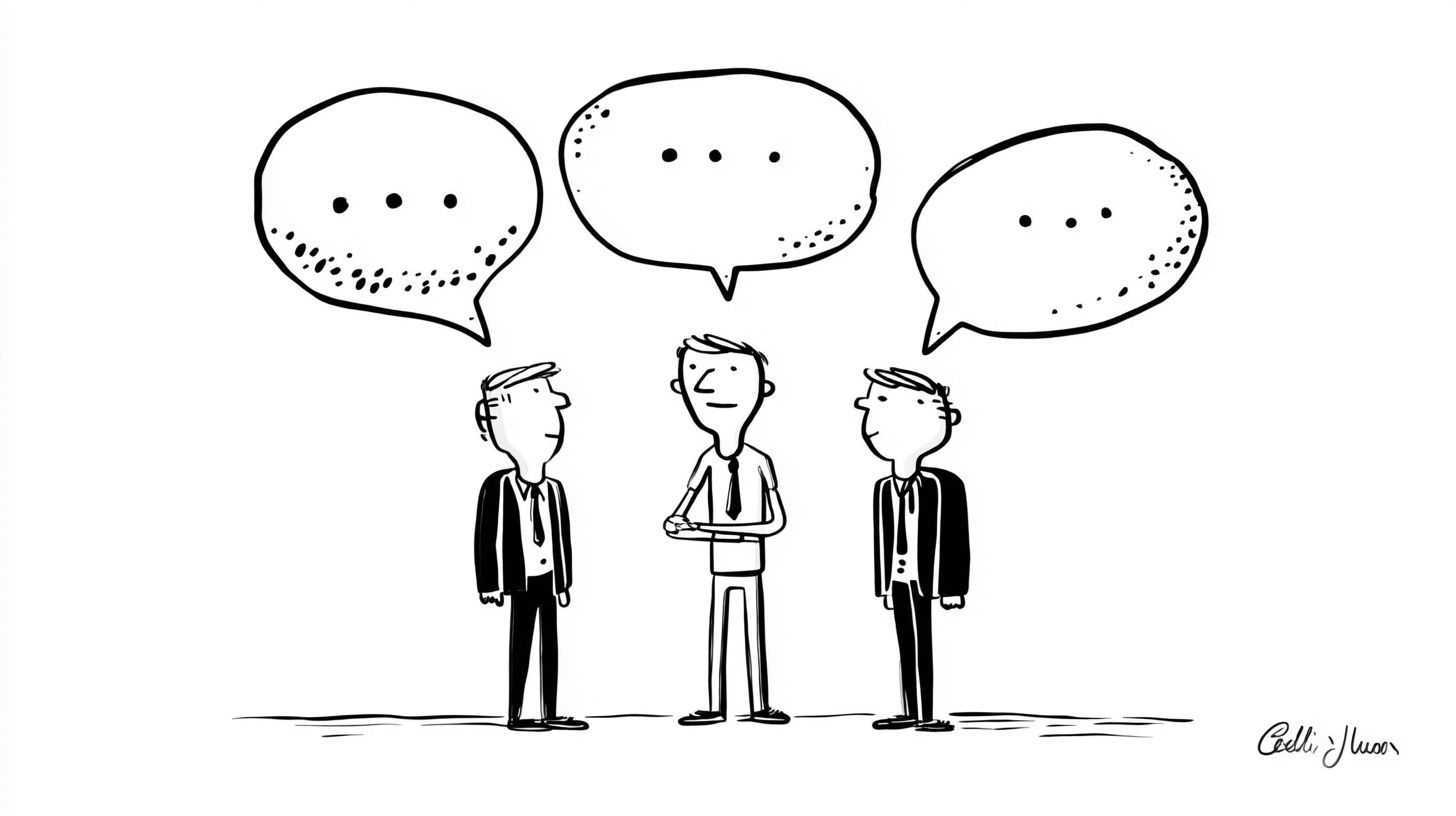
Cialdini’s research on social proof shows this. When everyone does something, doing it too doesn’t signal quality. It signals noise. A hundred identical B2B blogs create negative social proof. The presence of a ‘blog’ tab now means ‘we do what everyone else does.’
I wonder if this applies to other areas too. Like those ‘thought leader’ LinkedIn posts that all sound the same. It’s not just content marketing that’s broken. It’s the entire model of generic validation.
When we wrote our science communication articles for v1.4, something different happened. People didn’t just read them. They referenced them. A PM shared our Bayesian Knowledge Tracing piece in Slack. Someone bookmarked the spaced repetition article. These weren’t posts people skimmed and forgot.
If you think about Nir Eyal’s Hook Model, what was happening was subtle but important. The articles created what Eyal calls the Investment phase. Readers bookmarked them, shared them, built them into workflows. That investment loaded the next trigger. When a colleague asked ‘how does spaced repetition work?’, our article got pulled from someone’s bookmarks. Trigger → Action → Reward → Investment, repeating without us doing anything.
That was the signal I almost missed. The value wasn’t in content-as-marketing. It was in content-as-authority.
Why “Lab” Changes Everything
Words shape perception.
Any product team applying Norman’s design principles would recognize this. The label you put on something isn’t branding. It’s a UX decision that shapes every subsequent interaction.
When you see ‘Blog’ in a navigation bar, your guard goes up. You expect to be sold to. When you see ‘Lab,’ your predictions shift. You expect data, research, things that have been tested. Your guard comes down.
We made the switch in one commit. Changed the nav label. Added categories: Engineering, Voice, Science, Business Case. So the thirteen articles weren’t just a chronological feed. They were an organized body of research. We added search.
Small changes. But the positioning shift was massive. We weren’t a startup with a blog anymore. We were a research-driven company with a lab.
The thing I keep thinking about is this: your content should be a product, not a channel.
Gong Labs exists because Gong’s research on sales conversations is genuinely valuable on its own. Independent of whether you ever buy Gong. We asked ourselves: if ExecReps disappeared tomorrow, would The Lab still be worth visiting? If the answer is no, you’re doing content marketing. If the answer is yes, you’re building a research authority.
Building Calculators That People Use
The articles were a good start. But articles are still passive. You read them, you nod, you close the tab. I wanted something that would make the abstract cost of poor communication viscerally real.
This is where Don Norman’s Gulf of Evaluation was useful. The ‘gulf’ is the gap between what a system shows you and what you need to understand. Every HR leader knows bad communication costs money. But they can’t feel it. The cost is abstract, spread across thousands of hours nobody tracks. The gulf between ‘communication is expensive’ and ‘this costs your team $847,000 per year’ is enormous.
A calculator bridges it.
So we built three interactive calculators. Genuine analytical instruments, not lead-gen forms dressed up as tools.
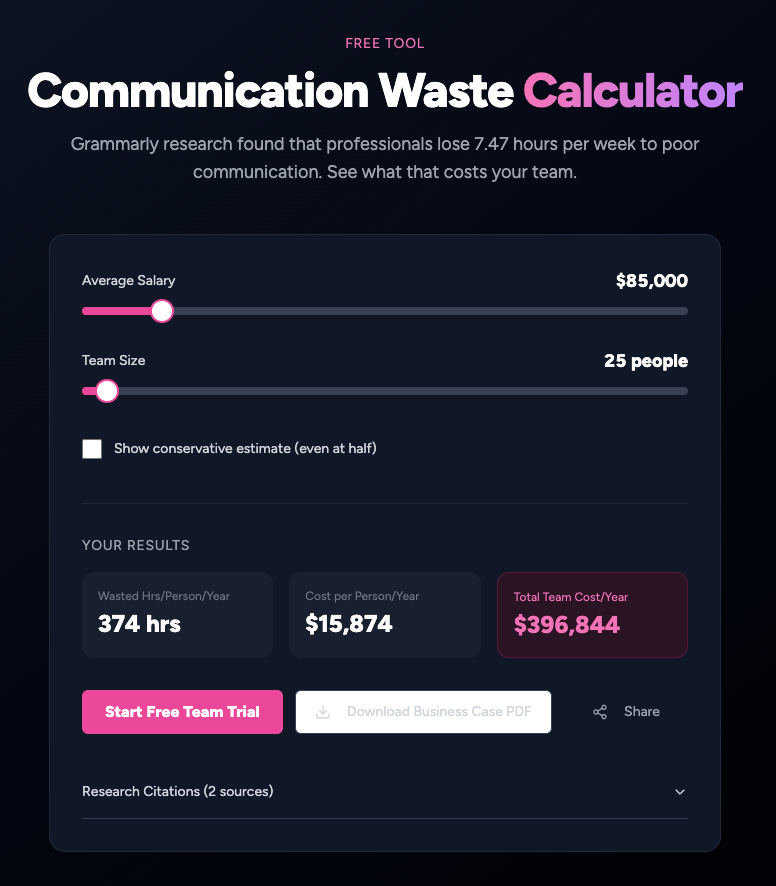
The Communication Waste Calculator. Grammarly’s research shows knowledge workers lose 7.47 hours per week to poor communication. Our calculator lets you plug in your team size and average salary. It computes exactly how much miscommunication costs your organization annually. In dollars.
[SCREENSHOT: The Communication Waste Calculator interface showing sliders for team size and average salary, with a real-time output showing annual communication waste in dollars and hours, with the Grammarly citation visible below.]
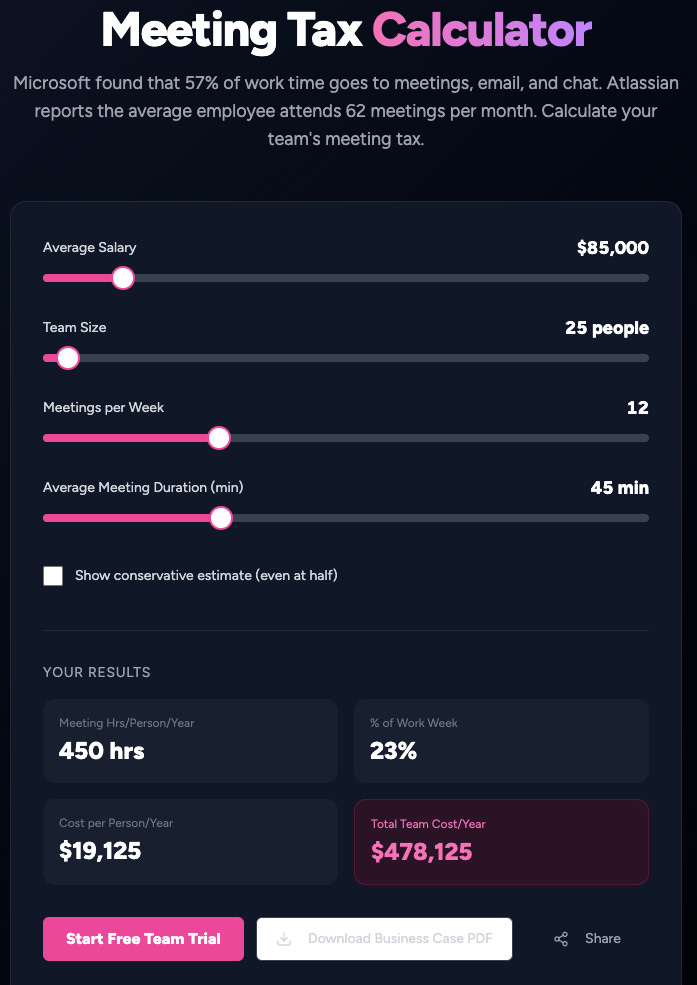
The Meeting Tax Calculator. Microsoft’s Work Trend Index: 57% of work time in meetings. Atlassian: 72% of meetings considered ineffective. Our calculator combines these data points. A manager can see, in hard numbers, what their meeting culture costs.
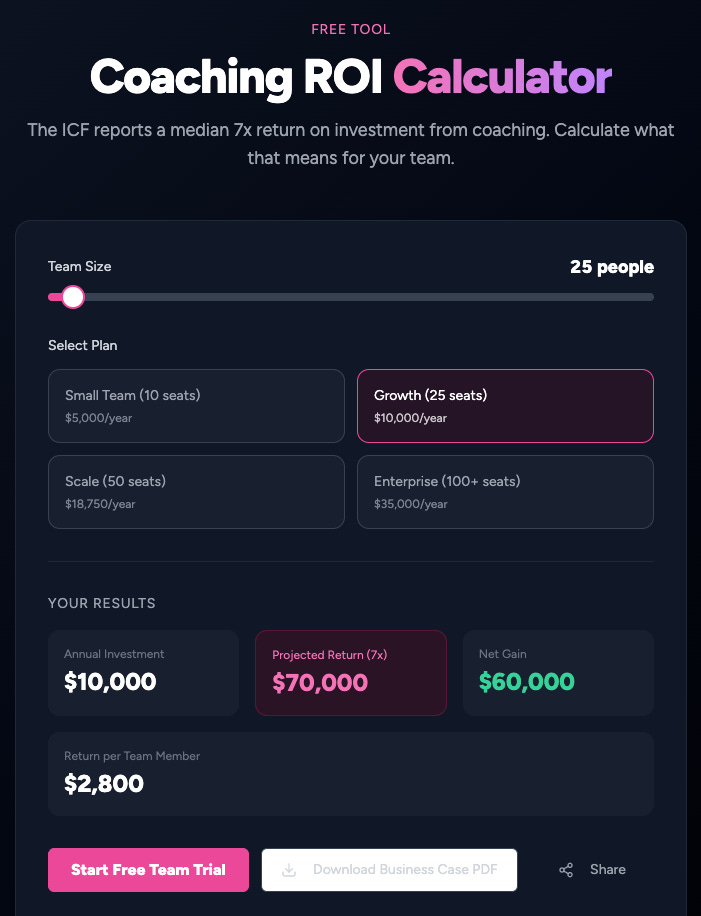
The Coaching ROI Calculator. The International Coaching Federation found a median ROI of 700% on coaching investments. Most HR leaders I’ve talked to can’t articulate the return on their coaching spend. Our calculator makes that possible.
The critical product decision came from thinking about BJ Fogg’s B=MAP model. Applied to buying, not just using. In B2B, your internal champion has to convince their CFO. That’s a behavior. Motivation, Ability, and Prompt all at once.
The champion’s motivation is already high. But their ability to make the business case? That’s where it collapses. Composing the internal pitch means deciding what numbers to cite, finding credible sources, framing the ROI, writing the email. Five cognitive steps before ‘send.’ Fogg is explicit: reducing friction on the Ability chain is almost always more effective than increasing motivation.
So we designed the calculators as ammunition. A champion pulls one up in a procurement conversation. ‘Look, here’s what this costs us. And here’s the source.’ We eliminated the mental effort bottleneck.
The Citations Are the Point
I want to zoom in on something here. It matters more than most founders realize. We cited everything.
Every number in every calculator links to its source. Grammarly’s State of Business Communication report. Microsoft’s Work Trend Index. Atlassian’s research on meeting effectiveness. The ICF’s global coaching study. Specific studies, specific findings, specific data points.
This is Cialdini’s Authority principle in its purest form. Authority isn’t about claiming expertise. It’s about demonstrating evidence. Showing your work is more persuasive than showing your credentials. When someone follows your citations, checks your sources, and finds you represented them accurately, they trust you. Because you gave them reasons to.
Most startup content falls apart here. ‘Studies show communication training improves performance by 40%.’ Which studies? Whose performance? The vagueness is a tell.
When we published The Lab, an enterprise prospect replied: ‘This is the first time a vendor has shown me research I can verify.’ That single sentence justified the entire effort.
Content As Product, Not Decoration
The era of content marketing is ending.
Not because content doesn’t matter. But because the bar has risen past the point where ‘helpful blog post’ clears it.
Any PM who’s used the Kano Model would recognize what’s happening. Traditional blog content is a ‘must-be’. Expected and ignored. Interactive tools grounded in verified research are ‘delighters’. They exceed expectations. And Kano’s insight is that delighters create disproportionate satisfaction precisely because nobody expects them.
I wonder if this applies to product features too. What was once a delighter quickly becomes a must-have. It’s an optimization target. The moment something new appears, the market catches up.
Apply three tests:
Does it solve a real problem? Our Communication Waste Calculator arms an internal champion with a dollar figure they can take to their CFO.
Is it differentiated? Anyone can write a blog post about meeting culture. Very few companies build an interactive tool that lets you model your own meeting tax with data from Microsoft and Atlassian studies.
Will people return to it? A blog post gets read once. A calculator gets used every time someone builds a business case. That’s the retention principle at the core of the Hook Model. Content that creates a return loop compounds. Content that doesn’t, decays.
What I Got Wrong First
I should be honest. We didn’t arrive at this on day one. Our first content efforts were conventional. Write blog posts. Share on social media. Hope for traction.
The v1.4 science articles were a step in the right direction. Genuinely rigorous. But they were still passive. Still organized chronologically in a format that signaled ‘blog.’
The leap to The Lab required killing a mental model I’d carried for years. That content exists to serve the funnel. I’d internalized the playbook so deeply that I initially saw our calculators as ‘bottom-of-funnel conversion tools.’
They’re not. They’re standalone products.
Daniel Pink’s research on intrinsic motivation maps onto this. When you give people tools that serve their Autonomy (use it on their own terms), Mastery (understand their problem better), and Purpose (make the case for change), they develop a relationship with your work that no conversion funnel can manufacture.
You’d think creating tools useful without your product would cannibalize the need for it. In practice, it does the opposite. Cialdini calls this Reciprocity. Genuine, unconditional giving creates obligation that no sales email can replicate. You build trust not by convincing people, but by helping them.
The Uncomfortable Truth About Authority
In the space we’re building in, communication, executive presence, voice coaching, there’s enormous noise. LinkedIn influencers selling ‘10 phrases that make you sound like a CEO.’ YouTube videos promising to ‘fix your voice in 7 days.’ Quick fixes from people who’ve never read a peer-reviewed study.
The people we’re building for, professionals told they ‘talk wrong,’ passed over because of an accent, they’ve been burned by quick fixes. They need to trust that what we’re building is grounded in something real.
The Lab is how we earn that trust. Not by saying ‘trust us.’ By saying ‘here’s our evidence, here are our sources, here’s a tool you can use yourself to verify the problem is real.’
Every time I look at The Lab, I think about that design agency phone call. ‘We can’t employ people who talk like you.’ A blog post telling them they were wrong wouldn’t have changed anything. But a calculator showing them exactly how much communication bias costs their organization? That might make them pause. Kahneman and Tversky’s research on loss aversion tells us people feel losses roughly twice as intensely as equivalent gains. A dollar figure attached to communication waste makes that loss tangible in a way no argument about fairness ever could.
Research doesn’t just build authority. It builds the case for change.
If we’re serious about the mission, that executive presence should not be a privilege, we need to be serious about the evidence that proves why it matters.
That’s why we killed our blog and built a lab. Not for the branding. For the mission.
What does this mean for every other startup with a ‘blog’ section? I wonder if the next wave of ‘content’ will look less like articles and more like tools.