


Brought to you by ExecReps.ai — AI-powered executive presence coaching for teams.
There was a quarter where a product team I was advising felt good about their retention numbers. Churn was down. The trend line was moving in the right direction. Morale was high.
Then someone ran the revenue churn numbers.
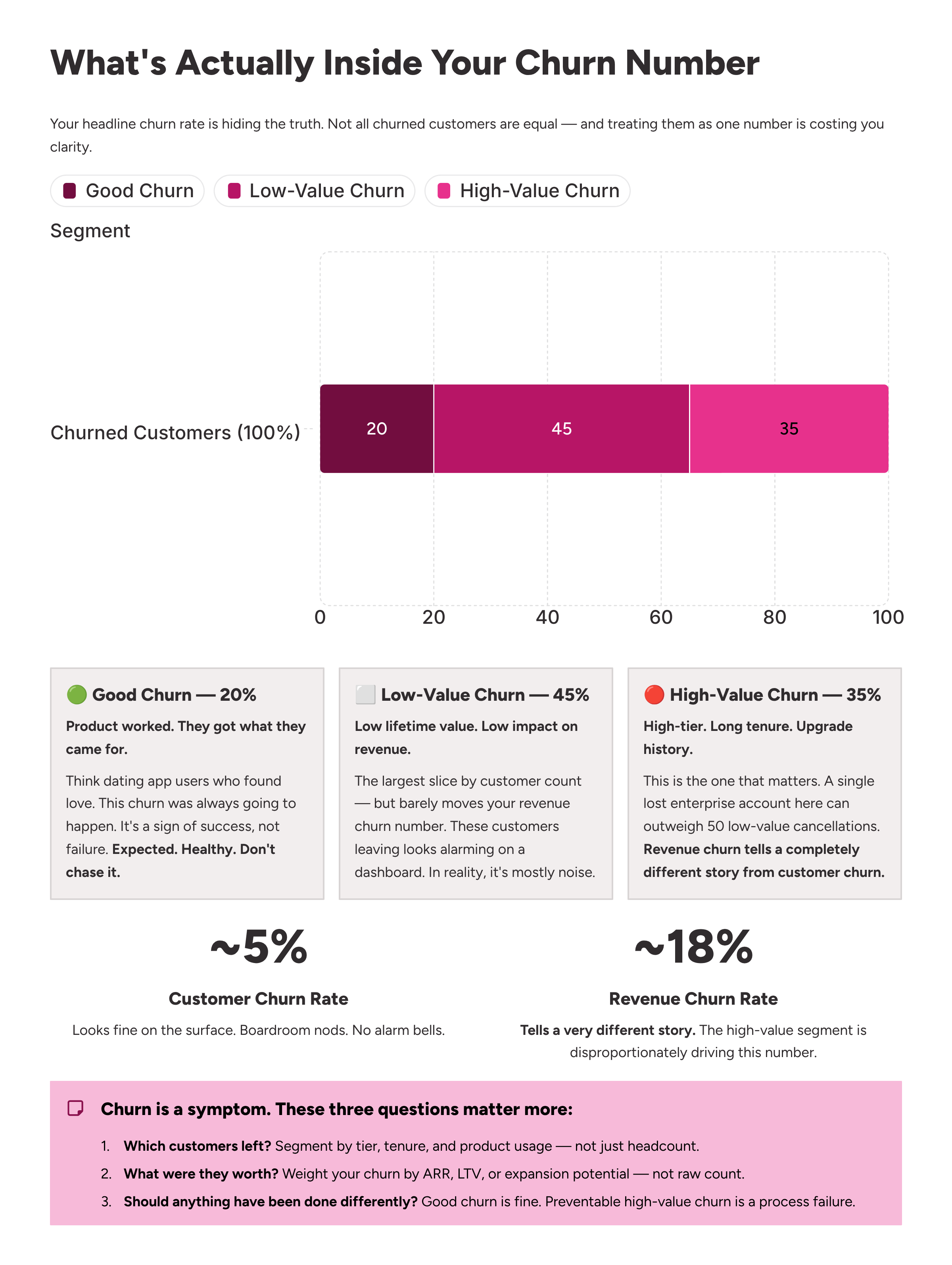
Turns out they’d kept almost everyone, but lost a disproportionate share of the customers who mattered most. The ones on higher tiers. The ones who upgraded. The ones who stayed a long time. Those were the ones quietly walking out.
Customer count said one thing. Revenue said another. They’d been celebrating the wrong number for six months.
Most conversations about churn start and end with rate. What is it? Is it going up or down? How does it compare to benchmarks?
But Carlos Gonzalez de Villaumbrosia, writing for Product Coalition, points to a distinction that doesn’t get nearly enough airtime: customer churn and revenue churn tell completely different stories. He puts it like this:
‘it’s better to lose six $5 customers than it is to lose one $100 customer. (Not that this is the rule for all businesses — it depends on the model!)’
The parenthetical matters more than the main point. It depends on the model. And the bit I keep turning over is whether most PMs have properly interrogated which situation they’re in.
The other thing that rarely comes up: good churn.
Carlos gives the example of a dating app. Someone leaves because they found love. That registers as churn in your dashboard. It isn’t. It’s the product working exactly as intended.
I wonder how many teams are running retention initiatives they shouldn’t be running. There’s a version of this where you add friction to cancellation, drip in discount emails, make leaving feel awkward — and you keep the customer long after your product stopped being the right fit for them.
Lee Fischman wrote a piece on achieving 90% retention in B2B and the line that stuck with me was almost a provocation: ‘the first reason our retention was so high was simply because customers needed our stuff. When they didn’t, they cancelled.’
The goal isn’t to eliminate churn. It’s to make sure the customers who should stay, do. That’s a different problem.
What that requires is harder than any retention playbook.
Asher Atlas wrote the best case study I’ve read on what happens when retention breaks not because of product quality, but because of trust. A licensing shift meant a huge chunk of their music catalog disappeared overnight. Users weren’t annoyed. They felt cheated.
The team’s instinct was to fix search. The insight they landed on: ‘What if this isn’t a search problem? What if this is a discovery problem?’
That reframe is doing a lot of work. The churn signal pointed at one thing. The root cause was something else. A team that only read their retention dashboard would have shipped the wrong fix.
There’s no clean framework here. The thing I keep coming back to is that churn is a symptom, not a diagnosis. And teams that treat it as a metric to optimise — rather than a signal to interrogate — tend to optimise it in the wrong direction.
The question worth asking isn’t just: why are people leaving? It’s: which people are leaving, what were they worth, and should anything have been done differently?
Some of those answers are uncomfortable. Some of them are ‘no.’
What have you seen? When did working on retention turn out to be solving the wrong problem?
- Jay