


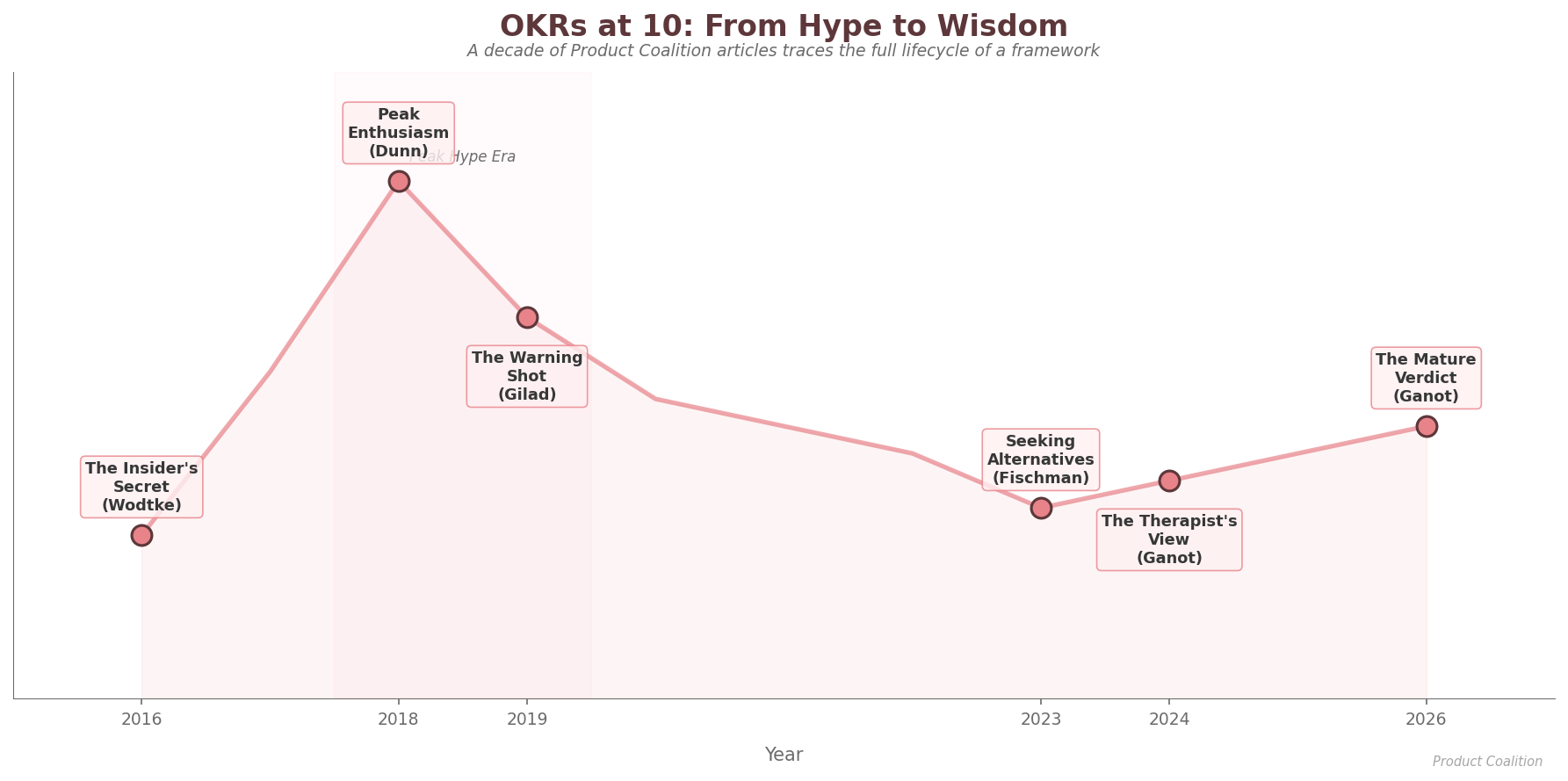
In 2018, Brad Dunn told Product Coalition readers they could implement OKRs in 30 days and "never look back." In 2026, Noa Ganot wrote that "the problem was never the framework." The journey between those two sentences took an entire industry to travel. I spent this week tracing it through our archive.
Brought to you by ExecReps, AI coaching that helps product leaders practice tough conversations before they satisfice easy ones
The Quiet Recommendation (2016)
Before OKRs became a mandate, they were a suggestion. Christina Wodtke, author of Radical Focus, mentioned them almost casually in her 2016 piece ‘The Three Jobs of Product Management.’ Her take:
“Vision holding is the most neglected job of a PM, yet it is the one that makes teams and product succeed. (OKRs can help!)”
That exclamation mark and parenthetical still make me smile. OKRs weren’t yet the thing every VP demanded in their quarterly planning session. Christina framed them as a useful tool alongside team norms and mission statements. A helper, not a religion.
“30 Days and You’ll Never Look Back” (2018)
Two years later, the tone changed completely. Brad Dunn’s ‘Moving to OKRs in 30 Days‘ captured peak enthusiasm perfectly. He opened with an admission that tells you everything about the era:
“I have been talking to a LOT of people over the last few months about OKRs, more than I thought I would actually. It is such a hot topic.”
Brad’s confidence was infectious. Follow his plan, and in 30 days you’d be transformed. But I love this moment of honesty buried deep in the optimism: “Trust us here. The first cycle you do will be a mess, just accept that and get the cadence and routines down.”
The seeds of disillusionment were planted right inside the hype. Most people skipped past that line. I bet they wished they hadn’t.
The Warning Shot (2019)
Then Itamar Gilad showed up. A former Google PM (the company most associated with OKR success), Itamar wrote ‘5 Ways Your Company May Be Misusing OKRs‘ and dropped what I consider the single most important sentence in a decade of OKR discourse:
“OKRs are just containers for goals. They serve bad goals just as well as they do good goals.”
That line changed my thinking about frameworks in general. Containers don’t care what you put inside them. Itamar went further: “Bad OKRs can amplify the issues the org is troubled with rather than fix them.” Coming from inside the Google house, this wasn’t a hot take. It was a warning from someone who had watched OKRs fail at scale.
Seeking Alternatives (2023)
By 2023, the community had started publishing “what to use instead of OKRs” articles, which is the clearest signal any framework has crested its hype curve. Lee Fischman’s ‘Goal-Question-Metrics: A Holistic Alternative to OKRs‘ proposed GQMs as a more rigorous approach. His critique was specific:
“Why is asking questions so worthwhile? Look at the examples above and notice how their Key Results are basically arbitrary.”
Arbitrary. That word landed hard with anyone who had sat through a quarterly planning session watching leadership pick Key Results out of thin air. Lee didn’t reject OKRs entirely, but he exposed a real weakness: the framework skips the “why are we measuring this?” step.
The Framework Survives (2024-2026)
This is the part that fascinates me most. Noa Ganot wrote about OKRs for Product Coalition twice, two years apart, and watching her thinking deepen is its own story.
In 2024, her piece ‘OKR Planning: Break the Chains‘ treated OKR problems as therapy problems: “OKRs are meant to bring your dreams into reality. If you don’t eliminate these limiting beliefs, you are left with a lot of reality that shapes and limits your dreams.”
By January 2026, her perspective in ‘When OKRs Don’t Work, the Problem Is Elsewhere‘ had sharpened into something more profound. OKRs fail because “they surface gaps teams have learned to live with: unclear priorities, postponed decisions, and ownership that isn’t as solid as it looks.”
And then the line that closes the loop on a decade of debate: “The framework forces the question, but it can’t force the answer.”
Noa didn’t flip-flop between those two articles. She deepened. That’s rarer than you’d think in product writing.
What I’m Hearing on the Podcast
Andrea Saez joined me recently to talk about product strategy alignment, and her thinking connects directly to the OKR misuse thread. She’s been vocal about the difference between vanity metrics and meaningful customer KPIs, which is exactly where most OKR implementations go sideways. Teams pick Key Results that look impressive in a slide deck rather than ones that reflect actual customer outcomes.
Alex Blinov made a related point about how the PM role is shifting from “mini CEO” to strategic architect. When your job definition changes, the goals you set and how you measure them have to change too. Most OKR frameworks haven’t caught up with that shift.
So What Does This Mean for You?
OKRs survived the hype cycle. Not because they’re perfect, but because the problem they force you to confront (do we actually know what we’re trying to achieve?) never goes away. The framework is just a mirror. If you don’t like what you see, the answer isn’t a better framework.
Are you still using OKRs? Have you modified them beyond recognition, or abandoned them entirely? I’d love to hear what actually works on your team. Hit reply and tell me.
You’re reading the Product Coalition newsletter. Every week, I dig into the archive of 3,500+ articles and 100+ podcast episodes to trace how product thinking has evolved. If someone forwarded this to you, subscribe here so you don’t miss the next one.
Jay Stansell · Lisbon, Portugal · Product Coalition