


Brought to you by ExecReps.ai — AI-powered executive presence coaching for teams.
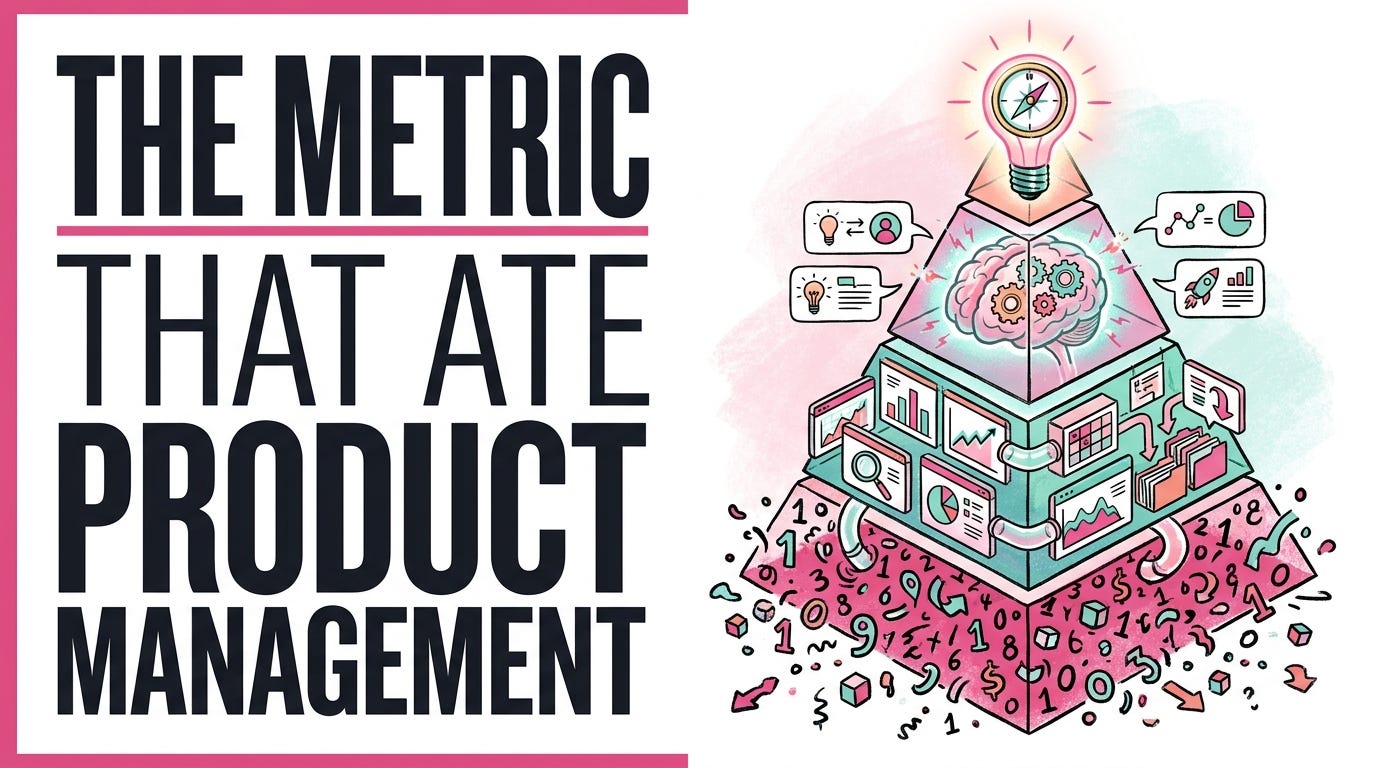
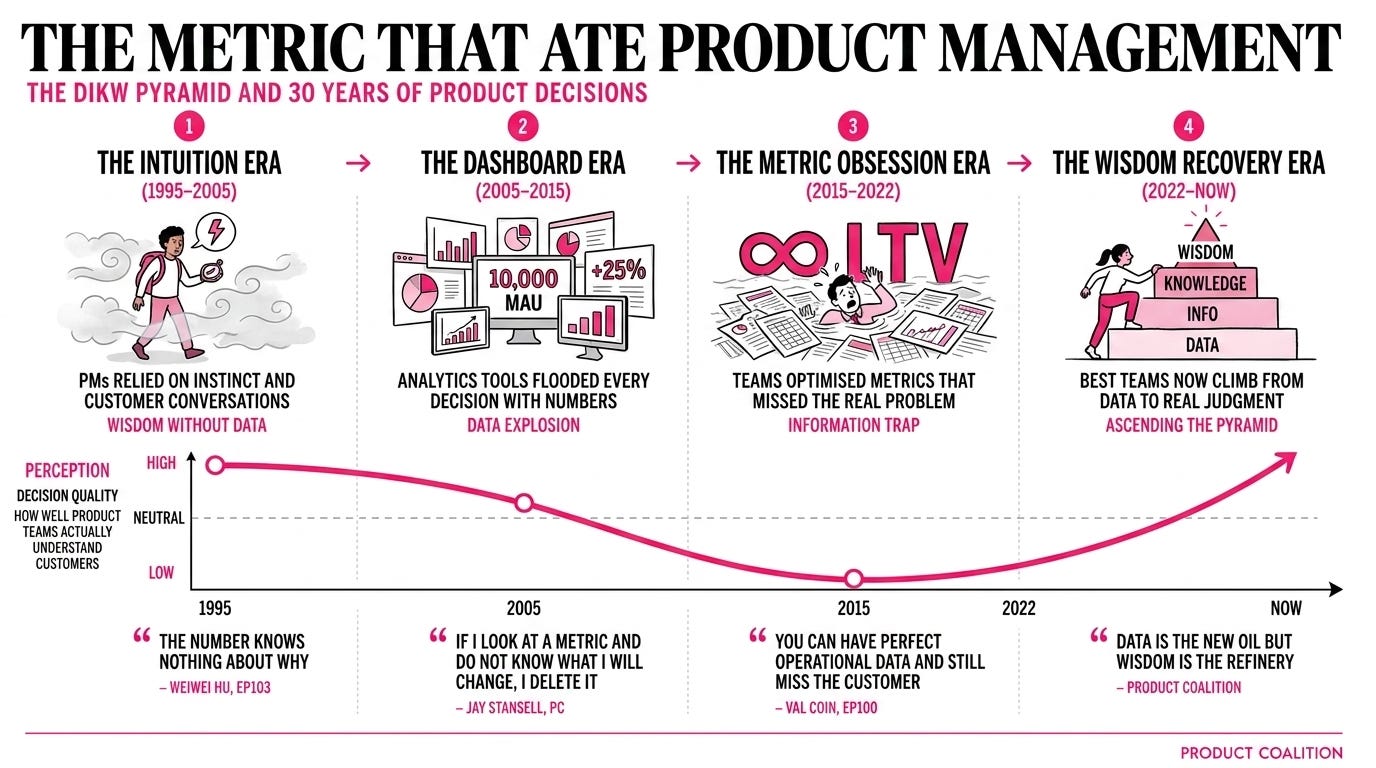
I pull out the DIKW Pyramid all the time. Data, Information, Knowledge, Wisdom. Four layers. I use it in conversations with PMs, in strategy workshops, in podcast episodes. I used it on air with Weiwei Hu when we talked about making analytics actionable, and again with Val Coin when we explored executive dashboards. It keeps showing up because it keeps being true.
These writers are product practitioners who have built, measured, and sometimes been burned by metrics in real organisations. They are writing from the trenches, not the textbook. Their work on Product Coalition captures the messy reality of what happens when you try to make numbers mean something.
Here is the framework in plain terms. Data is the raw number: 38. Information adds context: 38°C. Knowledge applies experience: that is a mild fever. Wisdom makes the call: take medication, cancel the meetings, rest. Most product teams I talk to are brilliant at collecting data and pretty good at turning it into information. Dashboards everywhere, charts in every meeting, weekly reports that nobody misses. But climbing from information to knowledge, and then from knowledge to wisdom, is where almost everyone gets stuck.
I have watched this play out across 12 years of running Product Coalition. The industry got so good at capturing numbers that we forgot why we were capturing them. As Weiwei Hu put it on the podcast: "98% of the time, the data's probably there. The analytics team did its job, but the insight never makes it into an actual decision. It stays trapped in a report that nobody reads or a dashboard that looks impressive in a meeting, but changes nothing afterwards."
That is the gap. Not a data gap. A wisdom gap.
The Data Layer: Measuring Everything, Understanding Nothing
Start at the bottom of the pyramid. Data is raw, unprocessed, context-free. A number in a cell. Product teams are drowning in it. The tools have never been better at collecting every click, scroll, hover, and abandonment. The problem is not access. The problem is that raw data creates a false sense of progress.
Ant Murphy nails this in Four Frameworks to Help You Define Product Metrics. He writes, "You can find numerous articles out there that will rattle off a list of essential e-commerce metrics or metrics for startup PMs however the universal problem with these types of articles are that you end up tracking metrics without fully understanding why or how they interplay and impact your product." His vegetable garden analogy is perfect. Measuring soil humidity and counting sprouts are leading indicators. If you are focused on the harvest when the plant is a seedling, you are going to get frustrated and stop watering the soil.
Murphy reminds us that "Every product, company, situation is different." There is no universal metric set. The data layer is necessary but it is not sufficient. It is the 38 without the °C.
The Information Layer: Context Without Consequence
One level up. Information is data that has been processed and organised. It answers who, what, where, and when. This is where most product teams live permanently. The dashboards, the weekly reports, the retention curves, the funnel charts. Information feels productive. It looks impressive in a meeting. It rarely changes anything.
Elena Seregina captures the specific feeling of dread that lives here in Metrics Hierarchy and Metrics Pyramid: Aligning Product and Business Goals. She writes, "Our business metrics were rising. But as we were cracking a bottle to celebrate, the metrics suddenly dropped." Classic information-layer trap. The top line looked great. The foundation was rotting. She argues that "On average, product leaders start building the hierarchy of metrics after a year of trying to tame the user data." A full year of drowning before you realise you need a map.
Weiwei described this beautifully on the podcast: "A lot of companies have a ton of data dashboards and reports. And now with AI, the ability to summarize from the data and to be able to generate information is very easy. But what I see is leaders and executives still struggle to decide what to do next." The information is everywhere. The decisions are nowhere.
The Knowledge Layer: Where Experience Meets the Numbers
This is where the pyramid gets steep. Knowledge is the application of information combined with experience, context, and critical thinking. It answers "How?" Most analytics teams never get here because they are too busy servicing the layers below.
Ally Mexicotte pushes into this territory in The Only Leading Metric to Measure Product-Market Fit and How to Use It. She brings up the Sean Ellis 40 percent rule: "if 40% or more of your users would be very disappointed if they could no longer use your product, then you've achieved product-market fit." That is not just information. That is knowledge. It takes a specific data point and applies a framework born from experience to make it actionable. But here is the part that requires real knowledge: Mexicotte explains that the people you should be listening to are not the ones who love everything or hate everything. It is the ones who would be "somewhat disappointed and whose main benefit was aligned to the core value proposition." The middle ground is where the work happens. You need experience to know that.
I said something on the podcast with Weiwei that I still believe: "When I think about the world pre-AI, most businesses when it comes to that analytics function had the data, could turn that into information, if they were invested in analytics teams or technologies they could acquire knowledge, but wisdom was left only to the human." The knowledge layer is where humans have always added the most value. AI is compressing the layers below it, which means the knowledge layer is now the minimum bar, not the aspiration.
Weiwei's response reinforced this: "The value for analytics actually will move away from pure execution to knowledge, insights, and judgment. Deciding whether a certain data signal or pattern really matters for a certain outcome, whether the result is trustworthy, even if it's generated by AI."
The Wisdom Layer: Judgment, Foresight, and the Courage to Ignore a Number
The top of the pyramid. Wisdom is the ability to use knowledge with judgment, foresight, and values to make sound decisions. It answers "Why?" and "What is best?" This is where you look at a metric and decide to ignore it. Not because you do not understand it, but because you understand it so deeply that you know it is the wrong signal for this moment.
John Utz writes about the seduction that keeps teams from reaching this layer in From Vanity Metrics to Actionable Insights: A Product Manager's Guide. He admits, "I've been enchanted by vanity." He warns that "vanity metrics can lure you in. They give you a dopamine hit, a surge of pleasure-inducing neurotransmitters in your brain." That dopamine hit is what keeps us trapped in the information layer. We want the chart that goes up and to the right, even if it has nothing to do with the health of the business. He cites Fab, which focused on user growth and ignored retention. Eric Ries said it plainly: "Vanity metrics may make you feel good, but they don't offer clear guidance for what to do next."
Wisdom is the test I use now. If I look at a number and I do not know what I am going to change or stop doing because of it, I delete it. That is not analytics. That is judgment. And it is the hardest thing in product to teach.
Weiwei told a story on the podcast that perfectly illustrates the gap between knowledge and wisdom. One of her team members built a price elasticity model in Databricks in just a few minutes using AI. "The model sounds really sophisticated and impressive. And then the same person came back to me the next day and say, I looked at the results, but it's completely wrong. It just sounds so confident and I almost believe it's correct, but it's just making, pulling these assumptions by itself without even asking me if this is the right assumption." The AI had data, information, and even a form of knowledge. What it lacked was wisdom: the judgment to know when its own assumptions were wrong.
Val Coin said it on another episode: "The data itself isn't sufficient. We need to understand what question is that data answering? What story is that data telling us and what does it allow us to do?" That is the wisdom question. Not what does the number say, but what does the number allow us to do next?
Climbing the Pyramid
The DIKW framework is not new. It has been around for decades. But it has never been more relevant than right now, because AI is collapsing the bottom two layers. Data collection is automated. Information generation is instant. AI can build a dashboard in seconds, write a summary in milliseconds, spot a pattern before a human has finished their coffee.
That means the competitive advantage has moved up the pyramid. The teams that win are the ones that can climb to knowledge and wisdom faster than their competitors. Not by collecting more data. Not by building more dashboards. By having the experience, the context, and the courage to make the call.
Weiwei put it best: "The best analytics teams are not just reporting or measuring or monitoring what happened. They are really the ones who help define and influence what should happen next."
When you look at your own product dashboards tomorrow morning, ask yourself honestly: which layer of the pyramid are you operating on? Are you collecting data, organising information, applying knowledge, or exercising wisdom? And if the answer is not wisdom, what would it take to climb one level higher?
These writers are the reason Product Coalition has been the home of real product thinking for 12 years. Ant Murphy's vegetable garden analogy for leading indicators, Elena Seregina's hierarchy that forces you to look at the whole house, Ally Mexicotte's reframe of who you should actually listen to, John Utz's honest confession about vanity. This is not content. This is craft from practitioners who have earned the right to teach it by doing the work first.
Sources
- Murphy, Ant. "Four Frameworks to Help You Define Product Metrics." Product Coalition on Medium.
- Seregina, Elena. "Metrics Hierarchy and Metrics Pyramid: Aligning Product and Business Goals." Product Coalition on Medium.
- Mexicotte, Ally. "The Only Leading Metric to Measure Product-Market Fit and How to Use It." Product Coalition on Medium.
- Utz, John. "From Vanity Metrics to Actionable Insights: A Product Manager's Guide." Product Coalition on Medium.
- Product Coalition Podcast. "EP103: From Data to Decisions — Making Analytics Actionable with AI" with Weiwei Hu.
- Product Coalition Podcast. "EP100: Operational Clarity — How to Make Digital Change Visible, Measurable & Scalable" with Val Coin.
- Ellis, Sean. "The Sean Ellis Test." Referenced via Mexicotte.
- Ries, Eric. The Lean Startup. Referenced via Utz.
👋 Jay