



Brought to you by ExecReps.ai, AI-powered executive presence coaching for teams.
I have sat through more north star metric workshops than I can now count, and most of them end on the same slide. One number, one arrow, a promise that if it climbs the business is safe. Product Coalition's own archive tells a slower, more honest story than that slide ever did.
I traced this metric once before, in April, and called its story a fall from gospel to cautionary tale. That reading was too generous. The number was never measuring the business, and the archive shows that from the start.
"Not everything that matters can be measured. Not everything that we can measure matters." Sebastian Straube, writing in Product Coalition
The Problem Came First
Product Coalition's early writing barely used the phrase north star. It talked about problems, and about the KPIs that should follow once a team understood one properly.
LX Cast set out the order plainly. "When you know the problem, you can set clear KPIs or key results that reflect the success of the customer." Diagnosis first, then the number that proves the diagnosis was right. Reverse that order and the metric stops meaning anything.
Every team I built with in that period ran the same test before a single tracking tool got installed. Could you name the customer's problem in one plain sentence? If nobody in the room could answer, the KPI conversation did not start, because there was nothing yet for a number to measure against.
I had made a version of the same argument two years before that, in a piece for the same publication. "A fundamental mistake is to think that a business can be propped up on single innovative product." A single product artefact was never the whole business, and a single metric was always going to inherit that same limit.
That was the mid-2010s. Nobody was arguing about one metric versus many yet, because the field had not agreed to compress the problem down to one number in the first place.
One Action, One Arrow
By 2020 the compression had happened, and it had a name. Carlos Gonzalez de Villaumbrosia gave it the clean test that every workshop still runs today: "to work out your north star metric, think about the one thing that a user can do with your product to help fix their problem."
Every product leader I have watched hear that test for the first time reaches for it instantly, because it ends an argument that has been running for months. Teams debating nine candidate metrics rarely ship anything, since everyone in the room can defend their own favourite. A single north star settles the debate through sheer design, no evidence required.
That design choice solved a real, expensive problem. Roadmap reviews stopped circling the same disagreement every quarter once one number was allowed to speak for the whole team. Prioritisation got faster, and product health became something you could read off a chart in a single glance.
A number chosen to end an argument is a different thing from a number proven to track the business. Nobody in 2020 pushed back on that distinction, because the metric still felt new enough to seem self-justifying. Growth teams adopted it fast precisely because it asked so little of them in return.
That single number then quietly took on a second job it was never built for. It stopped being a tie breaker for prioritisation and started standing in for the health of the whole product. Those are different jobs, and mixing them together is exactly where the 2022 correction had to begin.
Behaviour Is Not a Business Goal
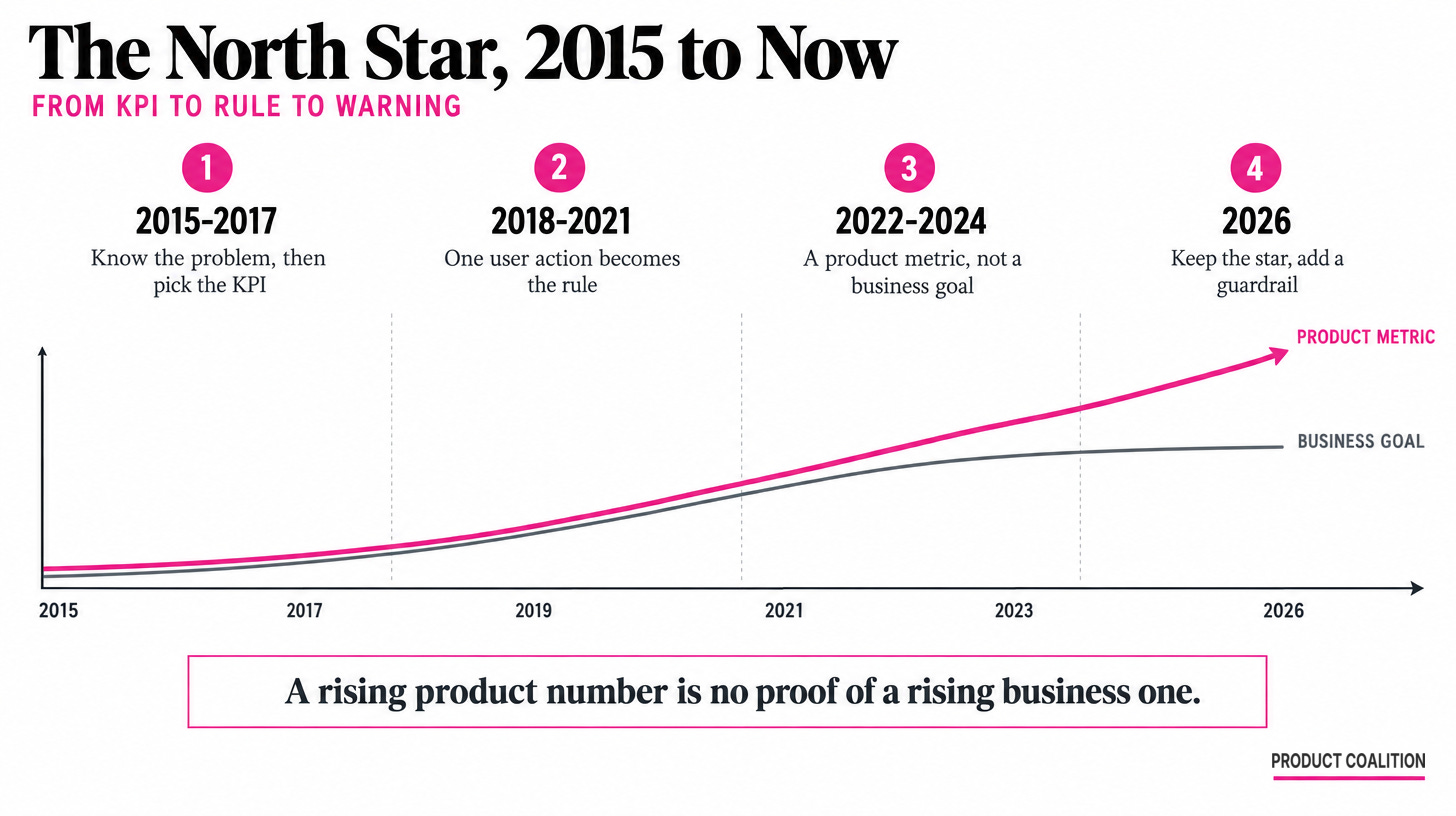
Two years into the decade the correction arrived, and it came from inside the same publication that had championed the idea. Elena Seregina named the flaw directly. "Some approaches suggest building the hierarchy of metrics from the most important one, also known as NSM. But it is not easy to define a proper NSM." Her next point is the one that matters most. A north star is a product metric, so it tracks what a customer does rather than what the business needs.
No team I have advised in the last five years has answered, without a long pause, whether their north star tracked revenue, retention or margin at all. It usually tracked none of the three directly. It tracked an action a customer took, and everyone assumed the business result would follow along behind it.
Seregina's guardrail belongs on every dashboard next to the north star, never underneath it. "Top-level metrics should not drop, even if the lower-level ones keep skyrocketing." A product metric only earns its keep while the business result above it holds steady. The moment that top line slips, the rising number underneath it stops being good news.
This is the whole correction, stated as plainly as the original claim ever was. The customer problem remained the real test of a useful measure the entire time. What changed was the confidence that a rising user action, sitting on its own, proves anything about the business built around it. A product team can be right about the behaviour and still be wrong about the business.
None of this makes the north star metric a bad idea. It makes it a partial one, useful exactly as far as the customer problem it was built to track, and no further than that.
What I'm Hearing on the Podcast
Weiwei Hu describes spending a large part of her career sitting between data, product and executive decisions. She walked me through watching this exact gap open up inside a live A/B test.
"Clicks will actually increase, but our retention didn't improve."
She finishes the thought a beat later, once the team has checked what happened downstream. "It may be we're just increasing the shallow engagement rather than a meaningful activation for our users and customers."
The rising number in her example was click-through rate rather than a formal north star. The failure sitting underneath it is identical regardless of which metric wears the name. A product number climbed, the team wanted to celebrate, and the business result above it, retention, stayed exactly where it started.
Her point was never that the test had lied. Watched alone, almost any single number will find a way to look like progress, which is precisely why it cannot be watched alone.
So What Does This Mean for You?
Keep your north star metric. Write the one sentence above it that names the specific business outcome it is meant to serve. Check the two against each other every month, not only when the product number happens to look good.
Avi Siegel put the deeper warning in a single sentence that has stayed with me since I first read it. "The problem is, raw data doesn't exactly exude 'information'."
A number moving in the right direction is a fact on its own. Whether it means what you hope has to be argued for separately, every single time you look at it. A number never argues its own case.
So take the one metric your team currently treats as settled. Which top-line business result has moved because of it, and when did you last check?
Got a product story worth telling? Whether you're an exceptional talent shaping the future of product, or you've got a career journey others can learn from, I want to hear from you. Apply to be a guest on the Product Coalition podcast.
👋 Jay
Product Coalition is a reader-supported publication. Paid subscribers get every issue on the day it lands.