


How product management’s favorite metric went from gospel to cautionary tale
I’ve been pulling North Star Metric articles out of our archive all week, and honestly? The pattern surprised me. In 2019, our contributors were so sure. One metric. One number. That’s all you need. Three years later, some of those same people were writing about how that advice nearly wrecked their product teams. I don’t think most of us caught the shift as it happened.
Brought to you by ExecReps, AI coaching that helps product leaders practice the conversations that matter most
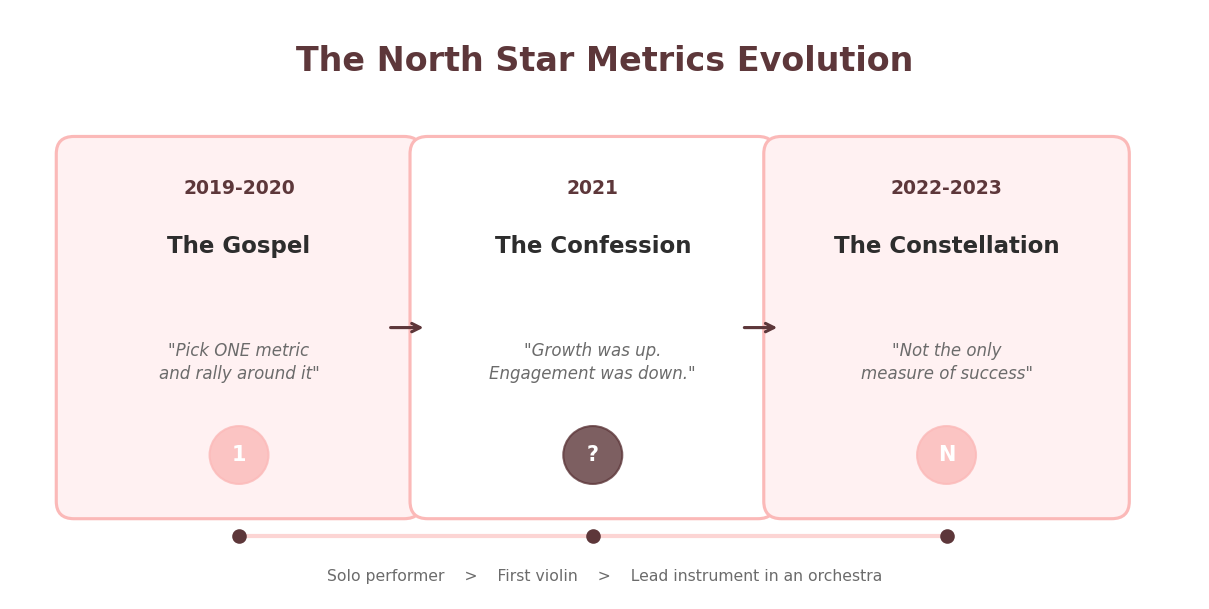
One Metric to Rule Them All (2019-2020)
If you want to feel the vibe of peak single-metric evangelism, go read Smit Shah’s ‘Tracking ‘One Metric That Matters’ (OMTM)‘ from September 2019. I pulled it up again this week. The certainty in it is wild:
“The concept of One Metric that Matters (OMTM) states that any organization should focus on optimizing only one metric that matters at that particular stage of the product’s lifecycle.”
Smit was channeling the spirit of the time. Pick one number. Align the team. Ship toward that number. He even acknowledged that the metric should shift as the product matures, but the core belief was unwavering: at any given moment, there is ONE number you should care about.
Six months later, Rashmi Shukla wrote ‘Product Metrics — How to Measure a Product‘ and slipped in the first crack. She argued for “chasing a north star metric accompanied by a few major metrics.” A few. Not one. Rashmi also dropped a warning that didn’t get enough attention at the time: focusing on MAU is “just another vanity metric” that hides the real picture of product stickiness.
I almost skipped that ‘a few’ caveat when I first read it. Seemed like a throwaway line. Turns out it was probably the most important sentence in the piece.
The Year the North Star Cracked (2021)
OK so here’s where it gets uncomfortable. Two pieces from 2021 basically describe the wreckage. People who followed the OMTM advice, did everything right by the book, and still ended up in trouble.
Tiziano Nessi wrote ‘How to Position Yourself as a Strong Product Manager From the Get-Go‘ and did something I don’t see often enough in our industry: he confessed to the exact mistake that the previous era’s advice had produced.
“I did the mistake to set the total number of users as an NSM. This led to a focus on the wrong value lever, and despite constant growth, the engaged users were decreasing...”
Read that again. Growth was going up. Engagement was going down. The North Star was shining and the product was quietly dying underneath it. That kind of failure mode doesn’t show up in a framework diagram.
Around the same time, Sebastian Straube published ‘North Star Metric — Measure the Right Thing‘ and reached back to 1956 for ammunition. He cited Ridgway’s classic critique:
“What gets measured gets managed — even when it’s pointless to measure and manage it, and even if it harms the purpose of the organisation to do so.”
Sebastian proposed a three-tier system: vanity metrics at the bottom, proxy metrics in the middle, business-aligned metrics at the top. The North Star should sit at Tier 1, sure, but only if it demonstrates “a clear and direct relationship between your product’s problem and the degree to which it is solving it.” Even that wasn’t enough on its own, because you still needed the lower tiers for context.
From Star to Constellation (2022-2023)
This is where the thinking got genuinely interesting.
I remember reading Elena Seregina’s May 2022 piece ‘Metrics Hierarchy and Metrics Pyramid‘ and thinking: finally, someone said it. She named the thing that had been bugging me for months:
“NSM is a product metric: most likely, it will measure customer behavior, not business goals.”
That distinction sounds small. It changes everything. Your North Star can be humming along perfectly while your business loses money. Elena proposed a layered pyramid with business goals at the top and product metrics below, each level checking the one above it. She also shared a story that stuck with me: “Our business metrics were rising. But as we were cracking a bottle to celebrate, the metrics suddenly dropped.”
By 2023, even the evangelists were hedging. Sriram Parthasarathy wrote ‘Decoding Business Growth: The Art and Science of Choosing the Right North Star Metric‘ and spent most of the piece making the case for NSMs. Then he landed here:
“While the North Star metric is a critical guide, it’s not the only measure of success. Companies should monitor other KPIs to ensure a balanced approach to growth.”
Sit with that for a second. Sriram just spent a whole article making the case for North Star Metrics. And his own conclusion is ‘not the only measure of success.’ That hedging at the end? That’s the sound of a correction happening in real time, right on the page.
What I’m Hearing on the Podcast
Bhav Patel came on the podcast to talk about fighting feature factories, and his rant connected directly to this whole metrics story. His argument: PMs became “feature managers” precisely because they lost the discipline of measurement. Not because they measured too little, but because they measured the wrong things and then stopped owning the numbers altogether.
“Product folks need to get their head out of their asses and start measuring what they do,” Bhav told us. His point isn’t that the North Star idea was wrong. It’s that most PMs never did the hard work of picking the right one, and when the single-metric approach failed them, they abandoned measurement entirely instead of fixing the metric.
So What Does This Mean for You?
The North Star didn’t die. It got demoted from solo act to lead instrument. The product community learned (sometimes painfully) that a single metric can focus a team, but it can also blind one. The fix isn’t to stop measuring what matters most. It’s to make sure ‘most’ isn’t doing all the work alone.
Here’s what I want to know: does your team still rally around one North Star, or have you moved to something more layered? Reply and tell me. I’m genuinely curious whether the correction has reached the teams doing the work, or if it’s still mostly happening in the articles.
You’re reading the Product Coalition newsletter. Every week, I dig into the archive of 3,500+ articles and 100+ podcast episodes to trace how product thinking has evolved. If someone forwarded this to you, subscribe here so you don’t miss the next one.
Jay Stansell · Lisbon, Portugal · Product Coalition