


Brought to you by ExecReps - AI coaching that helps product leaders practice the conversations that matter most
I asked a VP of Product last week what her product’s LTV-to-CAC ratio was. Smart person, ten years in product, ran a team of twelve.
She did not know. Not roughly. Not ballpark.
She could tell me her NPS was 62, her activation rate had improved 14% quarter over quarter, and her team shipped 23 features in the last cycle. All good numbers. But the one number the board asks first? Blank.
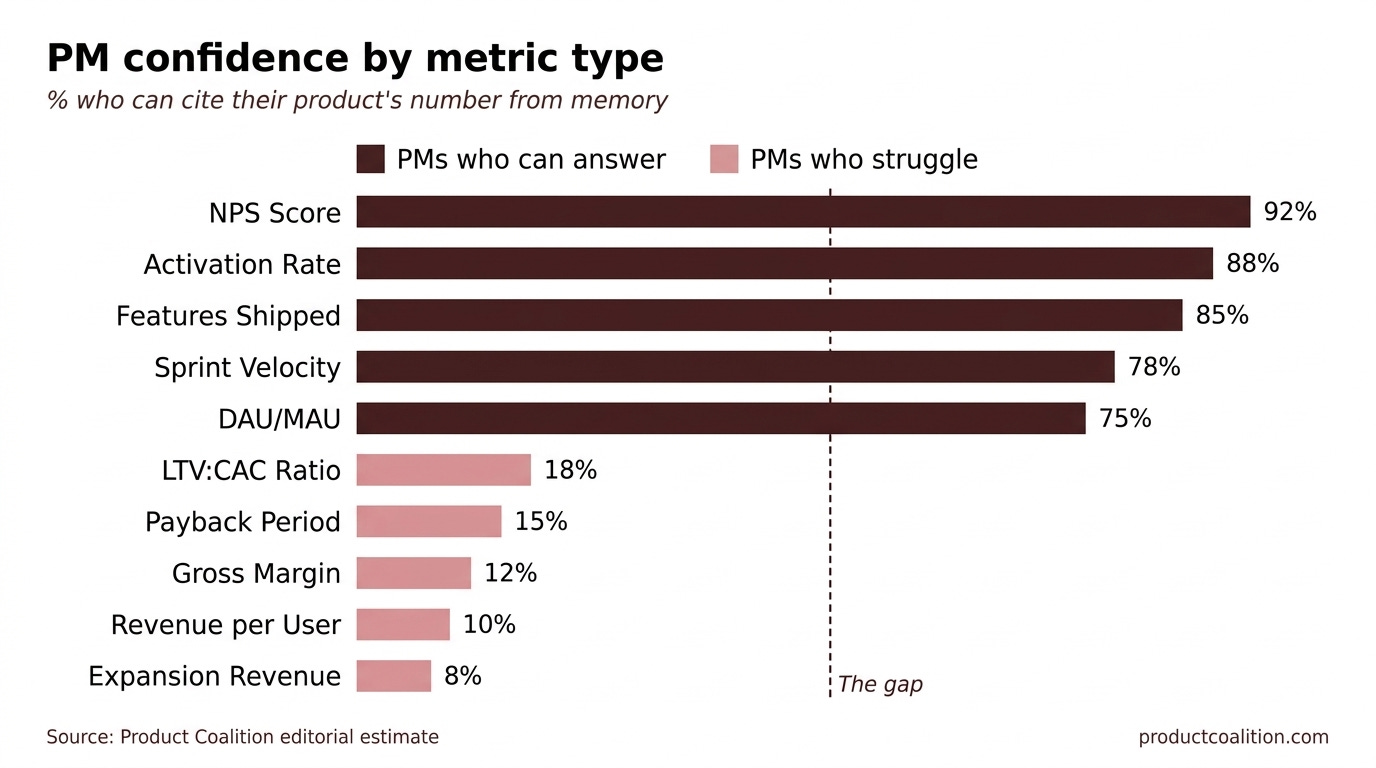
I keep seeing the same pattern. The product team walks into a QBR with activation funnels and cohort charts. The board wants to know when customers pay back their acquisition cost. Both sides leave frustrated, and nothing changes until someone gets cut from a budget review.
Nick Chasinov put it bluntly on Product Coalition: ‘If your CAC is higher than your LTV, it’s only a matter of time before the business closes its doors.’ Nick recommends a 3-to–1 ratio as the minimum healthy benchmark. I suspect most PMs reading this cannot say whether their product hits that or not.
And honestly, I do not blame them. I never learned this in any PM course I took either. Most of us pick it up only when a CFO forces the conversation, which usually means we are already behind.
John Utz shared a story that still bothers me. Fab, the e-commerce darling once valued at a billion dollars, tracked user registrations and website traffic religiously. John writes that they ‘overlooked the necessary metrics of customer retention and lifetime value.’ They poured money into acquisition, the top-line numbers looked incredible, and then the whole thing cratered.
Every metric Fab tracked was trending up. The business was dying anyway.
Olivia Tanuwidjaja explained on Product Coalition that CLV measures ‘the healthiness of our customer acquisition.’ I keep coming back to that word. Healthiness. Not size, not speed. Health. If your acquisition costs outpace what customers generate over their lifetime, you are not growing. You are spending faster.
The PMs who figure this out tend to move differently. Jon Matheson described the shift in his own career: he structured pricing so that ‘the LTV of premium users offsets the CAC within six months.’ That is not product language. That is board language. And it completely changed how his finance team engaged with the product roadmap.
Nicole Segerer made a related observation on my podcast. Most teams sit on mountains of usage data but have almost no visibility into how those numbers connect to revenue per customer. The data exists. Nobody is wiring it together.
Here is what I keep thinking about. Everyone in product is scrambling to learn AI tools and prompt engineering right now. Fair enough. But the PM who can walk into a board meeting and connect their roadmap to payback periods and gross margin? That person is rarer. And probably more valuable.
So here is what I want to know. What is the one unit economics number about your own product that you genuinely cannot calculate today? LTV-to-CAC ratio? Payback period by channel? Gross margin per feature? Hit reply and be honest. I am collecting these because I think there is a pattern in what product teams struggle to measure, and I want to write about it next.
Sources: Nick Chasinov - “Why Are Customer Acquisition Cost and Lifetime Value Important to Calculate?” (Jun 2023), John Utz - “From Vanity Metrics to Actionable Insights” (Aug 2024), Olivia Tanuwidjaja - “Customer Lifetime Value Explained” (Mar 2023), Jon Matheson - “Make Product Make Financial Sense” (Nov 2024), Nicole Segerer - Product Coalition Podcast. All published on Product Coalition.