


Brought to you by ExecReps.ai — AI-powered executive presence coaching for teams.
Everyone celebrates the pivot. Airbnb pivoted from air mattresses. Slack pivoted from a gaming company. Brex joined Y Combinator as a VR startup and left as a credit card company.
The writers behind this newsletter are product practitioners who’ve lived through pivots, rebuilds, and the uncomfortable silence that follows when a roadmap gets torn up. They write from the mess, not the post-mortem — and that’s what makes this community worth showing up for.
What nobody puts in the case study is the invoice. Not the engineering hours or the sunk development costs — those are obvious. I mean the other bill. The one that shows up in eroded customer trust, reset acquisition funnels, fractured team morale, and the six months of strategic drift that follows every major direction change.
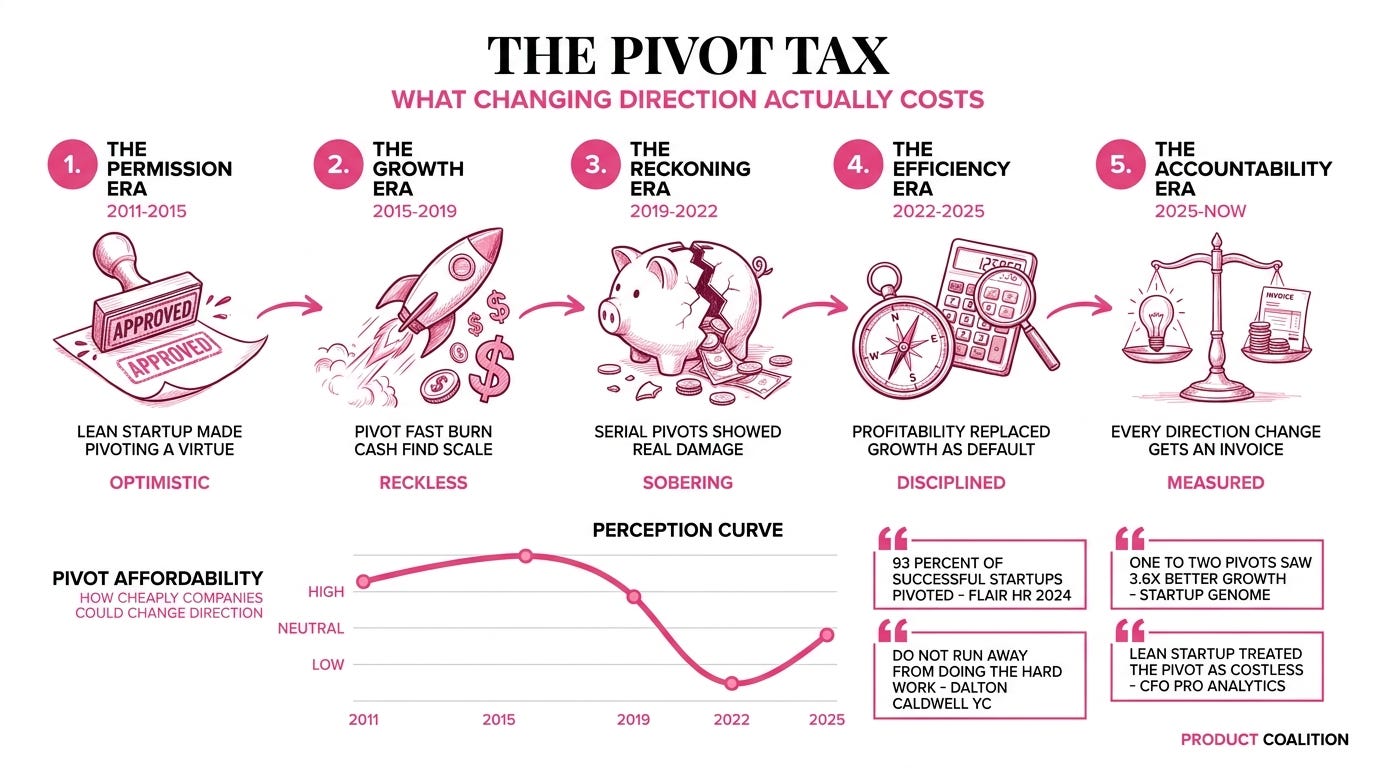
93% of successful startups pivoted from their initial ideas. That statistic gets quoted like a permission slip. But here’s the part that doesn’t make it into the LinkedIn posts: startups that pivot more than twice perform significantly worse than those that pivot once or twice. The Startup Genome Project found that companies with one to two pivots saw 3.6x better user growth and raised 2.5x more capital than those with zero pivots or more than two.
The pivot isn’t free. It never was. And in the current environment, where profitability has replaced growth-at-all-costs as the default operating mandate, every direction change carries a heavier price tag than it did five years ago.
The Five Hidden Costs Nobody Budgets For
1. The Customer Acquisition Reset
This is the biggest line item nobody puts on the spreadsheet. Every pivot resets your customer acquisition engine. The positioning you spent months refining? Gone. The messaging that finally started converting? Irrelevant. The sales playbook your team just memorised? Scrap it.
As CFO Pro Analytics put it bluntly: “The lean startup framework treated the pivot as essentially costless on the customer side. Sunk costs in product development were acknowledged and written off. The team redeployed. The next experiment began. What was never written off, because it was rarely measured properly, was the customer acquisition cost embedded in the failed experiment.”
AI has made this worse, not better. Building is cheaper than ever, which means the temptation to pivot is higher. But customer acquisition remains expensive and competitive. Testing multiple products in series multiplies CAC without compounding the relationship equity that makes acquisition efficient over time.
2. The Team Morale Drain
I’ve watched this one up close. A pivot announcement lands in an all-hands meeting, and for about 48 hours the energy is high. New direction! Fresh start! Then reality settles in.
The engineers who spent three months building the feature that just got killed? They’re doing the mental arithmetic on whether this new direction will survive long enough to ship. The designer who just finished a complete design system? She’s wondering why she should invest the same effort again. Your best people don’t leave immediately. They leave three months later, quietly, after the second pivot makes them feel like their work doesn’t matter.
The Startup Genome Project found that startups need 2-3x longer to validate their market than founders expect. That gap between expectation and reality is where team morale goes to die.
3. The Trust Erosion With Existing Customers
Nicole Segerer, General Manager at Revenera and a guest on the podcast, put the monetisation version of this problem perfectly: when companies implement changes too quickly without having the right data and without a solid strategy, the model goes wrong. “And when that goes wrong, you have a customer satisfaction issue, and you never want to have that. And then you’ve got to retract and change your pricing models, and that erodes trust.”
The trust tax compounds. Customers who lived through your first pivot give you a shorter leash on the second. Enterprise buyers start adding break clauses to contracts. Your NPS score doesn’t just dip, it develops a structural ceiling. And in B2B, where relationships are the acquisition channel, that ceiling becomes a revenue ceiling.
4. The Opportunity Cost Nobody Calculates
Every pivot is a bet that the new direction is worth more than the old one. That’s rational. What’s not rational is ignoring what you stop doing when you change direction.
Dan Balcauski, founder of Product Tranquility and a pricing expert who appeared on the podcast, captured a parallel truth about product decisions: “Most tech companies obsess over acquiring customers, but really neglect how they capture value.” The same logic applies to pivots. Companies obsess over the new direction but neglect to account for the value they’re walking away from.
That half-built feature that was three weeks from shipping? The partnership that was two meetings from signing? The customer segment that was just starting to convert? These aren’t sunk costs. They’re abandoned upside. And nobody puts abandoned upside on a pivot spreadsheet.
5. The Technical Debt Reset
This one is insidious because it’s invisible for months. A pivot doesn’t just change what you’re building. It changes the relevance of everything you’ve already built. Database schemas designed for one use case become structural constraints for another. APIs built for one integration pattern need rebuilding. The monitoring and alerting you set up for the old product? Useless for the new one.
Dave West, CEO of Scrum.org and a guest on the podcast, has spent years advocating for incremental delivery precisely because it reduces this kind of waste. His model is built around “making small bets” — the idea that teams should incrementally deliver, learn, and adapt rather than making massive directional bets that require equally massive unwinding when they don’t work.
What I Am Hearing on the Podcast
The pivot conversation keeps surfacing across episodes, even when the topic isn’t explicitly about pivoting.
Dave West described his philosophy on the podcast: “Making small bets, the ideas of making things transparent, backlogs, having clear goals, product goals, sprint goals, bringing teams together to own both the process and the product — those ideas, I would like everybody to practice.” The subtext is clear: if you’re making small bets, you never have to make the expensive big pivot. You course-correct incrementally.
Dan Balcauski offered a lens that applies directly to the pivot question. He observed that “one of the things that a lot of companies just miss is they don’t have any governance at all around pricing” — and the same is true of strategic direction changes. Companies that lack governance around pivots end up with what he described: “The CEO comes in and yells at everyone because there’s a pricing problem and everyone kind of sheepishly looks around the room... nothing ever changes.”
Nicole Segerer highlighted the profitability blind spot: “80% of companies will have launched some sort of AI functionality. But when you really go deeper and you look at, okay, are customers using this? And is it something that carries some value that people would actually pay for? That creates a whole different picture.” Launching something new, whether it’s a pivot or a feature, without validating that customers will actually pay for it, is the most expensive experiment you can run.
The Pivot Decision Framework
So when should you actually pivot? Shubhi Nigam, writing for Mind the Product, outlined a framework that deserves more attention than it gets:
1. Usage: Are your metrics in sustained decline? Not a bad quarter. A structural trend.
2. Vision: Does the product no longer align with where the company needs to go?
3. Viability: Can you ever make money on this product?
4. Exhausted options: Have you genuinely tried everything, or are you pivoting to avoid doing the hard work?
That last question is the one most teams skip. Dalton Caldwell from Y Combinator nailed it: “Do not run away from doing the hard work. Sometimes you see people where they build a product, and right when it gets to sales time, they pivot, and they do that over and over again.”
The pivot is not the problem. The problem is pivoting without accounting for the full cost. Before you change direction, add up the real invoice: the CAC reset, the team morale drain, the customer trust erosion, the opportunity cost, and the technical debt reset. If the new direction is still worth it after that honest accounting, then pivot with conviction. If not, the cheaper move might be to stay the course and do the hard work you’ve been avoiding.
What the writers in this community keep proving, issue after issue, is that the messy middle is where the real product work happens. Not in the pivot announcement. Not in the “we’ve found product-market fit” press release. In the daily grind of shipping, measuring, listening, and adjusting by degrees. These writers are doing the work. This newsletter exists because of them.
Sources
Startup Failure Rate Statistics — flair
Startup Genome Project — Startup Genome
The Hidden Cost of the Pivot — CFO Pro Analytics
State of Product 2026 — Atlassian
To Pivot or to Not — Mind the Product
All About Pivoting — Y Combinator
Startup Failure Rate: How Many Startups Fail and Why — Failory
👋 Jay