


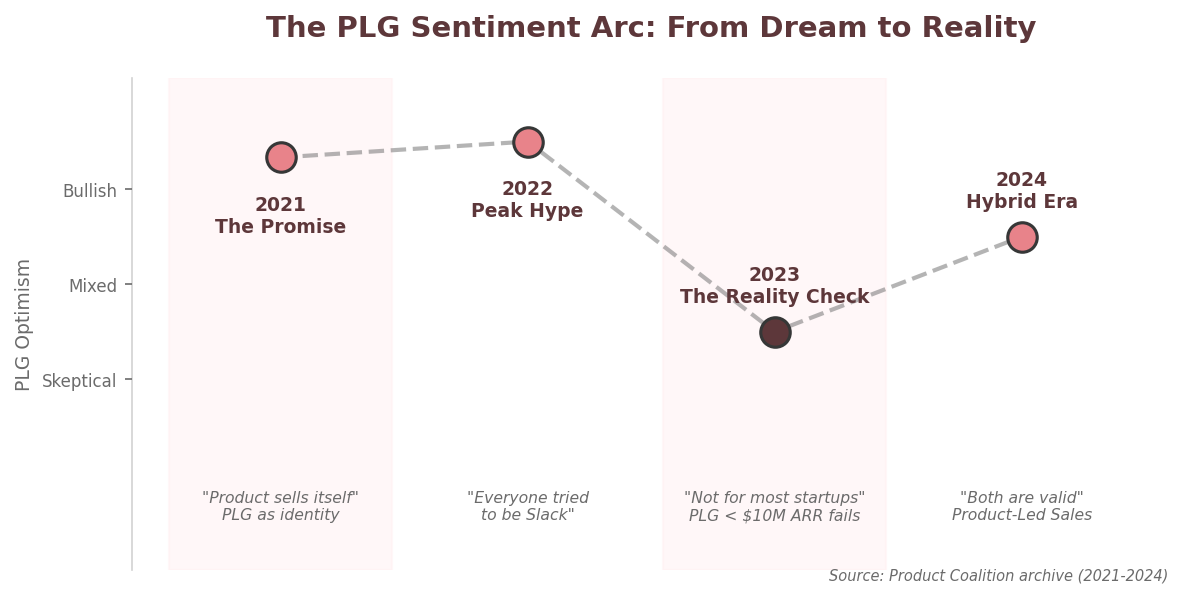
I’ve been reading through our archive of Product-Led Growth articles this week, and something funny kept happening. The earlier the piece, the more certain the author sounded. By 2023, everyone was hedging. That arc tells a story worth tracing.
Brought to you by ExecReps, AI coaching that helps product leaders practice tough conversations before they satisfice easy ones
When the Product Sold Itself (2021)
In 2021, Michelle Yick wrote a piece for us called ‘How to Spot a Product-Led Company‘ that captured the PLG dream perfectly:
“If sales, marketing, and customer support disappeared, the core product would still attract and retain users (albeit at a slower growth rate).”
Think about that claim for a second. If your entire go-to-market team vanished, you’d still grow. That was the promise. And for a handful of companies, it seemed true. Michelle pointed to Zoom as proof: “Remember when you tried Zoom and immediately told your friends, coworkers, and overseas relatives with terrible wifi to switch over?”
Around the same time, Sandhya Hegde published ‘The 3 Modes of Product-led Growth,’ tracing PLG’s roots back further than most people realize. She argued that “1983 was the true birth year of product-led growth,” pointing to AOL free trials and the GNU open-source movement. By 2006, companies like Box and Skype had the playbook: “giving away free plans and trials to entice their end users to adopt software that could grow virally within companies.”
Every startup wanted to be the next Slack. PLG wasn’t just a go-to-market strategy. It was an identity.
Everybody Tried to Be Slack (2022)
Surrbhi Soni’s ‘Slack: A Product Led Growth Strategy Case‘ reads like peak evangelism. Slack, Dropbox, and Zoom had “removed the myth that without product manuals, traditional lead generation, sales demos, and POC setup, a product cannot grow.”
But buried in the same article was a counterpoint nobody wanted to hear:
“Microsoft launched Team in 2016 and took over many customers of Slack, and currently has almost twice as many daily active users as Slack.”
Microsoft Teams didn’t win on product experience. It won by being free with Office 365. Enterprise CTOs picked the bundle, not the better tool. That should have been a warning sign for the whole PLG movement. But in 2022, the hype was still running hot.
Meanwhile, Noa Ganot was already seeing the backlash build. In ‘Three Wrong Reasons to Give Up on Product-led Growth,’ she pushed back against lazy dismissals. Her observation was sharp: “Product-led company and product-led growth are two different things. While you can’t do PLG without being a product-led company, the other way around is not necessarily true.”
That distinction matters more than most people realize. A lot of companies thought they were doing PLG when they were really just not hiring salespeople.
The Confession Booth (2023)
This is where it gets honest. Guy Barner, a founder who actually built a PLG company, wrote ‘To PLG, or not to PLG?‘ and dropped this line:
“Even though we went with PLG, I still don’t think it’s the best choice for most startups.”
That’s a PLG founder saying PLG probably isn’t for you. He went further: “Trust me, there are zero sales-led startups with good onboarding.” Sounds like a point for PLG until you read the rest. Guy explained that PLG requires you to nail everything at once: lead generation, website conversion, onboarding, product quality, and a freemium model that converts. With sales-led, you need a good product and good salespeople. That’s it.
Then Noa Ganot came back with ‘Product-Led Growth Is a Misleading Name‘ and shared a stat that stopped me cold:
“Research shows that up until $10M ARR, it’s much easier to succeed without PLG than with it. After $10M ARR the opposite is true, and PLG wins big time.”
So PLG works best for companies that already have serious traction. But most of the advice and tooling is aimed at early-stage startups. That gap explains a lot of the wreckage.
The Hybrid Reality (2024)
By 2024, the conversation had matured. Mart Objartel wrote about the challenges of choosing between product-led and sales-led strategies in ‘Navigating Challenges in Product-Led vs. Sales-Led Strategies for B2B SaaS,’ and he dropped the either/or framing entirely. His warning was practical: companies shift between strategies all the time, “sometimes subtly, akin to the proverbial frog boiling.” The real danger isn’t picking wrong. It’s changing direction without telling your product team.
Mart also highlighted something that rarely gets discussed. In sales-driven organizations, “aspiring product managers often feel constrained in effectively managing their products.” The PLG dream wasn’t just about growth metrics. For a lot of PMs, it was about autonomy. That’s partly why the backlash stung.
What I’m Hearing on the Podcast
Dan Balcauski joined me on the podcast to talk about SaaS pricing and packaging, and his perspective connects to PLG’s blind spot. Freemium tiers, trial-to-paid conversion, the whole pricing ladder that PLG depends on: those are the execution details where most companies fall apart. Dan’s insight about understanding customer value through qualitative research (not just usage data) explains why so many self-serve funnels leak. The product might sell itself. But if your pricing doesn’t match how customers experience value, the self-serve model collapses anyway.
(Listen to EP83 with Dan Balcauski)
So What Does This Mean for You?
PLG isn’t dead. But ‘PLG alone’ was always a mirage. The companies that tried to be Slack learned that being Slack requires being Slack: massive network effects, a product category that spreads virally, and enough runway to survive years of free users before revenue catches up. Most products don’t have those conditions.
What actually works for most teams is a hybrid. A product good enough that users want to try it, paired with humans who help close the deal. Not glamorous. Very effective.
I’m curious: did your company try PLG and pivot away? Or are you still running a self-serve motion? Reply and tell me how it’s going. I genuinely want to know.
You’re reading the Product Coalition newsletter. Every week, I dig into the archive of 3,500+ articles and 100+ podcast episodes to trace how product thinking has evolved. If someone forwarded this to you, subscribe here so you don’t miss the next one.
Jay Stansell · Lisbon, Portugal · Product Coalition