


Brought to you by ExecReps.ai — AI-powered executive presence coaching for teams.
👉 If you're not a subscriber yet, subscribe here so you don't miss the next issue.
Product Coalition writers have been mapping this fault line for years, from multiple continents and across company sizes most analysts never bother to study. Ron A, Pulkit Agrawal, Clayton Tarics, Chris Miles, Jon Matheson, Navneet Maheshwari, and Product Dave bring practitioner-level clarity to a debate that the conference circuit keeps oversimplifying. What follows owes everything to their fieldwork.
I sat in an advisory session last month watching a founder try to explain his software to a potential buyer. He stumbled through technical specs for ten minutes while the buyer stared blankly. It was a painful reminder of what happens when the person holding the microphone cannot tell a story that lands.
That scene is playing out across thousands of product organisations right now. Not because people lack talent, but because nobody can agree on whose job the story actually is.
The divide between the product manager and the product marketing manager started as a practical split. It has since become a philosophical one. And if the last decade of restructurings, layoffs, and AI tooling has taught me anything, it is this: the question is no longer "PM or PMM?" The question is whether the story even survives the divorce.
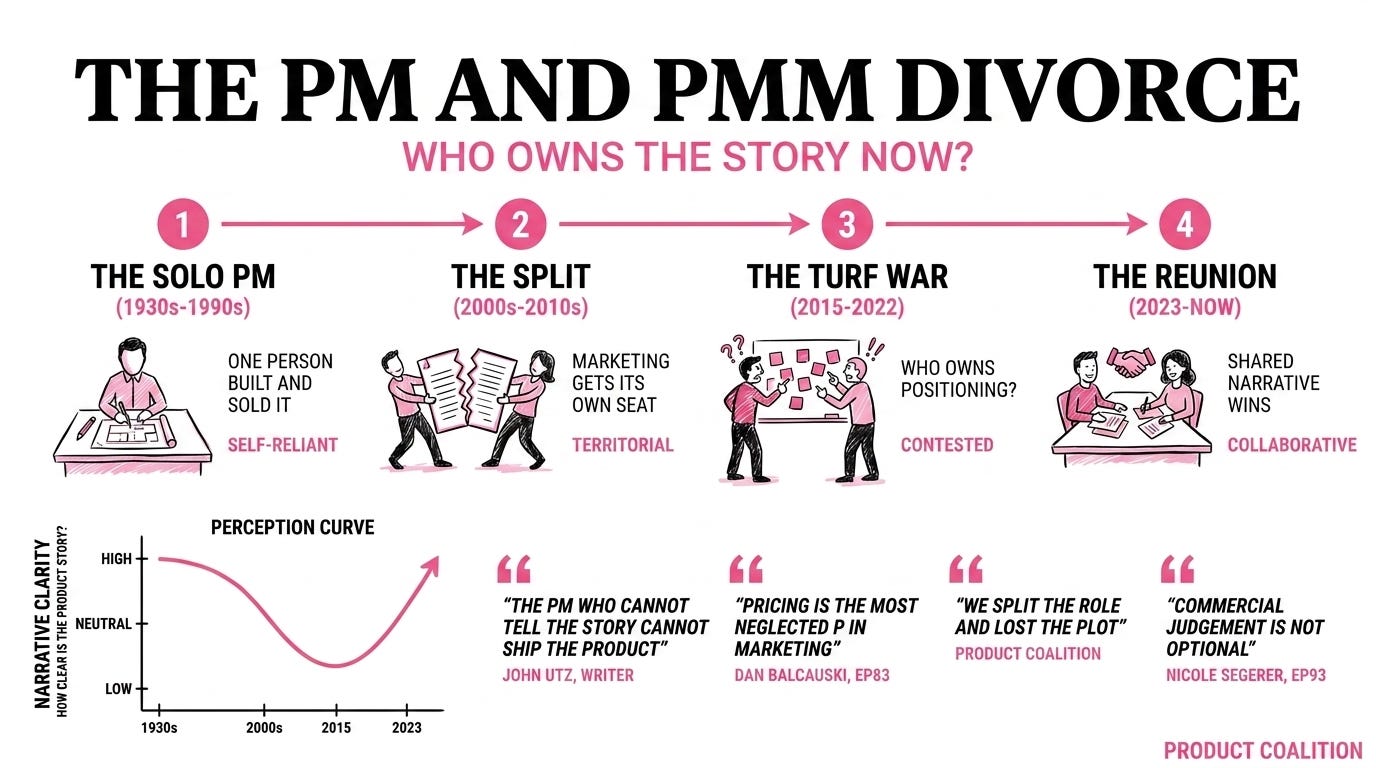
Era 1: One Person Did Everything (1930s–2000)
The product manager role did not begin in Silicon Valley. It started at Procter & Gamble in 1931, when a junior executive named Neil McElroy wrote a now-famous three-page memo arguing that each brand needed a dedicated "brand man" who would own the product, the positioning, the advertising, and the relationship with the consumer.
For decades, one person did it all. The brand manager was the strategist, the storyteller, and the commercial owner. There was no divorce because there was no marriage to dissolve.
Dan Balcauski, founder of Product Tranquility, made this point when he joined me on the podcast: "Product management has only existed as a function for 30, 40 years at most, borrowed from the CPG companies, the brand management companies, brand managers." The role was born whole, and it stayed whole for a remarkably long time.
When software companies began adapting the brand management model in the 1980s and 1990s, the PM inherited the same broad mandate: understand the market, build the right thing, and tell the story that makes people care. In an era of packaged software and annual release cycles, one person could realistically hold all three threads.
Era 2: The Great Specialisation (2000–2015)
Then SaaS changed everything.
Continuous deployment, freemium acquisition funnels, self-serve onboarding, and always-on analytics created a volume of work that no single role could absorb. The PM was pulled deeper into engineering sprints, API roadmaps, and backlog grooming. The story, the positioning, the launch, the competitive intelligence, all of it needed a dedicated home.
Enter the Product Marketing Manager.
Ron A captures the confusion of this era perfectly in What Does a PMM Do? It Depends: "A Product Marketing Manager is one of the least understood roles in the technology industry." He explains that "the role of the PMM can vary dramatically between companies," sometimes sitting under marketing, sometimes under product, and sometimes reporting directly to a founder who is not entirely sure what they hired.
Pulkit Agrawal went a step further and tried to pin down the role empirically. In What is Product Marketing? A Data-Backed Definition, he crawled more than 40 job descriptions and concluded that "a Product Marketing Manager plays a critical role in a company's success by connecting the dots between a product and its market." Three areas kept surfacing across nearly every listing: product launch strategy, customer engagement, and competitive analysis.
The specialisation made sense on paper. The PM would own the "what" and "why." The PMM would own the "who hears about it" and "how it lands." But in practice, the split introduced a new problem: nobody could agree where one role ended and the other began.
Chris Miles mapped this fragmentation in What Is Each Flavour of Product Manager Responsible For?, identifying four distinct PM quadrants, each with different levels of overlap with marketing. A Growth PM lives almost entirely in acquisition and retention metrics. A Technical PM barely touches the customer narrative at all. Multiply that by the PMM variants (Launch PMM, Competitive Intel PMM, Enablement PMM) and you have a Venn diagram that looks more like a Jackson Pollock.
The result? Go-to-market became a relay race where the baton kept hitting the floor.
Era 3: The Merge Heard Round the Valley (2016–2023)
By 2023, the backlash had arrived in full force.
Brian Chesky at Airbnb made headlines by flattening the PM function entirely, pulling product managers out of their traditional role and centralising design-led decision-making under creative leadership. It was controversial, polarising, and, for a lot of working PMs, terrifying.
Product Dave pushed back directly in No, Airbnb Is Not Killing the Product Function, arguing that what Chesky did was specific to Airbnb's culture and scale, not a universal playbook. The product function was evolving, not dying. But the signal was clear: senior leadership was losing patience with a system that had created more handoffs than outcomes.
At the same time, a quieter movement was happening inside mid-size companies. Teams were realising that the PM who could not tell a commercial story was stuck in a backlog, and the PMM who could not read a roadmap was stuck in a slide deck. The most effective practitioners were the ones who refused to stay in their lane.
Jon Matheson captured this perfectly in The Commercial Side of Product: What I Learned the Hard Way: "I thought building a great product was enough. I was wrong." His confession reads like a warning label for every PM who has ever shipped a technically brilliant feature that nobody bought.
Dan Balcauski put a finer point on the ownership question when I asked him who should own pricing: "My advice is product marketing should own it. I believe that pricing is a function of positioning. And so usually product marketing is at least the keeper of positioning in the organisation." But he added a caveat that every PM should hear: "Product management tends to have a little bit too much on their plate to also rigorously own pricing, but they're definitely a key stakeholder at the table."
Nicole Segerer, General Manager at Revenera, echoed the same tension from the commercial side on the podcast: "It is a topic that everyone would like to have a say and have an opinion in. But as you say, no one really wants to own it." She went on to describe the failure mode: product teams that build pricing strategies in isolation, only to have the CFO veto them at the last minute because nobody got executive buy-in early enough.
The era of the merge was not about eliminating roles. It was about acknowledging that the split had created a governance vacuum. Someone needed to own the narrative end-to-end, and the org chart was not going to solve it.
Era 4: AI Rewrites the Job Description (2024–Present)
And then AI arrived, and the question of "who owns the story" became something else entirely: "does anyone need to?"
Generative AI can now draft positioning documents, write launch copy, analyse competitive landscapes, summarise customer calls, and generate go-to-market briefs in minutes. The mechanical outputs that once justified the PMM headcount, and padded the PM's workload, are increasingly handled by tools.
Clayton Tarics anticipated this shift in Strategy Storytelling: The Product Narrative Canvas, where he argued that "the magic formula for high-impact product strategy presentation is to utilise a [product narrative] + [system of stories] approach." His point was that the value is not in the document. It is in the thinking. "A narrative is a contextual container for a system of stories," he wrote, and no AI tool is building that container on its own. Not yet, anyway.
Navneet Maheshwari's GTM Strategy template makes a similar argument from the execution side: "A GTM strategy is the plan that a company puts in place to bring a product to market." The template is only useful if a human has done the hard thinking about customer segments, value propositions, and channel strategy. AI can fill in boxes. It cannot decide which boxes matter.
So where does that leave us?
The PM who refuses to think commercially is a backlog administrator. The PMM who cannot influence the roadmap is a PowerPoint artist. And the AI that does both is still a tool looking for a strategist to point it in the right direction.
The practitioners who will thrive in this era are the ones who treat the PM-PMM boundary as a collaboration surface, not a property line. They are the ones who understand that the story is not an afterthought bolted onto a feature release. It is the product. It always has been.
What I Am Hearing on the Podcast
Dan Balcauski (EP83) told a joke that was not really a joke: "A CMO, a CRO, and a CPO all walk into a boardroom. Who's accountable for pricing? Well, it's always the CEO. The CEO is responsible for everything." His point was that the absence of explicit governance around pricing, and by extension around the narrative, creates a vacuum that defaults upward. If nobody owns the story, the CEO ends up telling it, and they are usually the least close to the customer.
Nicole Segerer (EP93) reinforced this from the commercial side: "Build a good team, bring the right people together, always make sure that sales and channel are part of the discussion, and then let's make sure that there is executive sponsorship." The teams that get this right are not arguing about whether the PM or the PMM writes the positioning doc. They are sitting in the same room, with the same data, building the same narrative.
I keep coming back to that founder. He had possibly the best product in his category. He had the data to prove it. And he lost the deal because nobody had helped him turn the specs into a story.
That is the cost of the divorce. Not the org chart reshuffling. The real cost is the silence where a narrative should be.
The PM and the PMM do not need to merge back into one role. They need to stop treating the story like a baton to be passed and start treating it like a fire to be tended. Together.
What are you seeing on your team? Has the PM-PMM boundary helped or hurt the way your product reaches the market? I would love to hear from the messy middle.
These writers are doing the real work. Ron A mapped a role that most job descriptions still get wrong. Pulkit Agrawal brought data to a debate drowning in opinion. Chris Miles showed us that the PM role itself has fractured into at least four distinct flavours, each with its own relationship to the market. Clayton Tarics built a canvas that forces strategists to think about narrative before they think about features. Navneet Maheshwari gave teams a template that turns vague GTM ambitions into actionable plans. Jon Matheson admitted out loud what most PMs only whisper to themselves: that building a great product was never enough. And Product Dave kept the conversation honest when the industry wanted to panic about Airbnb. This is what Product Coalition exists for: giving working practitioners a platform to share what they have actually learned, not just what sounds good on a conference stage.
Sources: - Ron A, What Does a PMM Do? It Depends, Product Coalition - Pulkit Agrawal, What is Product Marketing? A Data-Backed Definition, Product Coalition - Chris Miles, What Is Each Flavour of Product Manager Responsible For?, Product Coalition - Clayton Tarics, Strategy Storytelling: The Product Narrative Canvas, Product Coalition - Navneet Maheshwari, A Template for Great Go-to-Market (GTM) Strategy, Product Coalition - Jon Matheson, The Commercial Side of Product: What I Learned the Hard Way, Product Coalition - Product Dave, No, Airbnb Is Not Killing the Product Function, Product Coalition - Dan Balcauski, EP83: Profit by Design — Mastering SaaS Pricing and Packaging, Product Coalition Podcast - Nicole Segerer, EP93: Monetize This — Data, AI and the Future of Software Pricing, Product Coalition Podcast
👋 Jay