

The $3,000 framework that quietly became table stakes
How design thinking went from Stanford gospel to the framework nobody names anymore

Somewhere around 2021, I sat through a design thinking workshop where a senior VP put a Post-It on a whiteboard that just said “empathy.” Everyone nodded. Nobody asked what it meant. I think that was the moment I knew something had gone sideways with this framework. So I went back through our archive to see how we got from Stanford d.school reverence to… that.
Brought to you by ExecReps — AI-powered executive coaching for product leaders. Product Coalition members get extended access.
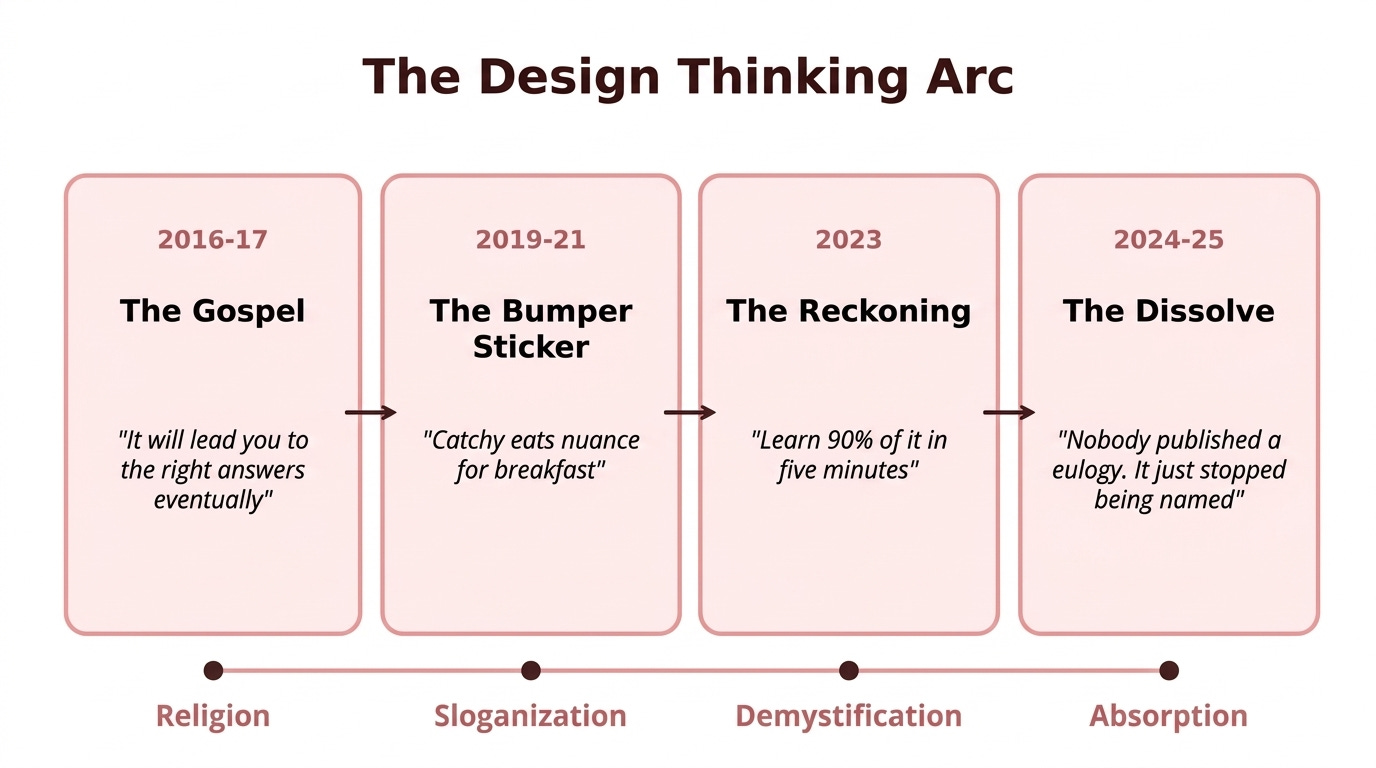
The Convert Era (2016–2017)
In 2016, Amit Badlani came out of Stanford’s d.school and wrote about it like someone who’d found religion:
“The design thinking framework has helped me traverse the problem space and stay patient. Design thinking is all about iterating. It is not a magical process that guarantees solutions to the challenging problems. It will, however, lead you to the right answers eventually.”
“Lead you to the right answers eventually.” That’s pure faith. And I don’t mean that dismissively. If you’d gone through that program in 2016, you probably felt it too. The prototyping, the reframing, the permission to throw your first idea away. It felt new.
By 2017, demand had outrun supply. Yasith Abeynayaka built a self-study guide for people who couldn’t get to Palo Alto, calling design thinking “a mandatory skillset” for professionals. The d.school-to-IDEO-to-Google-Ventures pipeline was becoming the canonical path. If you cared about product, you were supposed to care about this.
The Bumper Sticker Problem (2019–2021)
Then the sloganization kicked in. Sefi Keller wrote a piece in 2019 that I keep coming back to:
“The problem is that as time goes by, many people find it hard to unpack the depth behind the idea’s ‘sticker version’ and might dismiss it altogether.”
She was talking specifically about empathy, and how it had been reduced to a step on a diagram. Her point was subtle and important: the people who created design thinking made it catchy on purpose, because leaders need bumper stickers to rally teams. But catchy eats nuance for breakfast.
Meanwhile, by 2021, Nathan Mckinley was writing five-stage explainers citing Apple, Disney, IBM, and Microsoft as proof that design thinking worked. Stanford teaches it. Harvard endorses it. This was DT at its most institutional, and maybe its most hollow.
“You Can Learn 90% of It in Five Minutes” (2023)
The backlash didn’t arrive as a single takedown. It crept in.
Lee Fischman wrote a piece in 2023 that basically said the quiet part out loud:
“The Design Thinking folks say ‘It’s method, not magic’ and they’re right, but I’d go one step further: it’s obvious and you already do it.”
His framing: before design thinking, design was a priesthood. After, it was democratized. Involve diverse people. Iterate. That’s it. The $3,000 MIT certificate was teaching you something you probably already knew.
Jackie Colburn published a workshop guide that same year acknowledging what everyone felt: people have been “burned in the past by inefficient, unproductive, and boring sessions that feel like a waste of time.” We’d turned design thinking into a calendar invite people dreaded. Post-Its were still there. The magic wasn’t.
The Quiet Dissolution (2024)
Here’s what surprised me. I pulled up Connor Joyce’s 2024 piece on building AI products, expecting at least a nod to design thinking. Nothing. The whole article is about LLM integration, deployment strategy, user outcomes. The closest you get is “just because it’s powerful doesn’t mean it’s the answer for everything,” which is basically empathy wearing different clothes.
Design thinking didn’t die dramatically. Nobody published a eulogy. It just… stopped being named. The principles got absorbed into how competent teams work. Table stakes now, not a framework.
What I’m Hearing on the Podcast
Rachel Wolan, CPO at Webflow, came on the show recently and put it well: “Human creativity remains vital in the design process, even with AI automation.” She never used the phrase ‘design thinking.’ She didn’t need to. The human-centered instinct is still there. It’s just no longer branded.
So What Actually Replaced It?
I’m not sure anything replaced it so much as the industry grew out of needing a name for it. The best PMs I talk to empathize with users, prototype quickly, iterate constantly. They just call it product management.
Maybe design thinking succeeded so completely it became invisible. Or maybe we just got tired of the Post-Its.
What’s your read? Did design thinking win by dissolving, or did we just collectively agree to stop talking about it? Reply and tell me. I genuinely don’t know the answer.
You’re reading the Product Coalition newsletter. Every week, I dig into the archive of 3,500+ articles and 100+ podcast episodes to trace how product thinking has evolved. If someone forwarded this to you, subscribe here so you don’t miss the next one.
Jay Stansell · Lisbon, Portugal · Product Coalition