


Brought to you by ExecReps - AI coaching that helps product leaders practice the conversations that matter most
I counted once. In a single quarter, a team I was advising ran fourteen experiments on their onboarding flow. Fourteen. Button copy, tooltip placement, that little progress bar at the top.
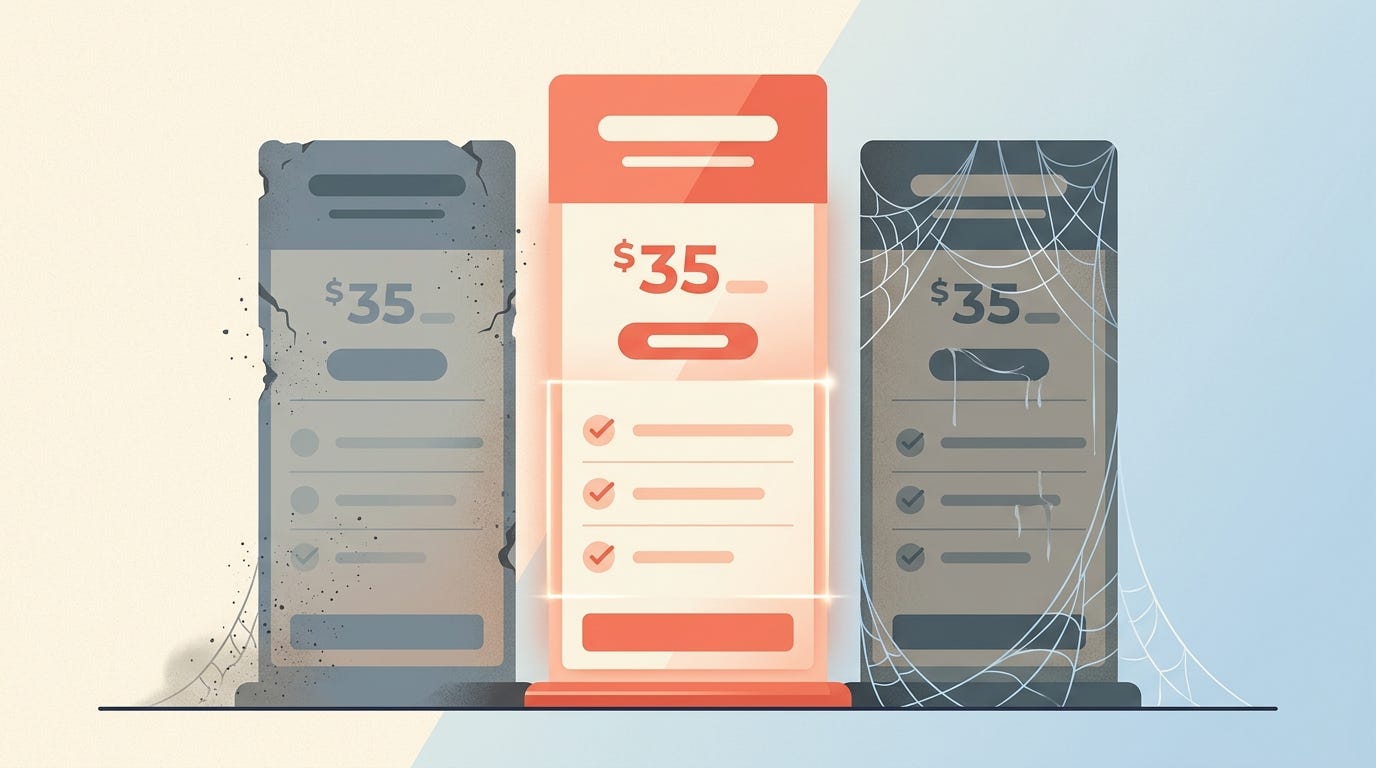
You know how many experiments they ran on the pricing page in the same quarter? Zero. And this was a team that prided itself on being data-driven about everything.
I keep noticing this pattern and I am not sure I fully understand it yet. The pricing page is somehow sacred ground. Nobody runs real experiments on it.
Ivo Valchev wrote a case study on Product Coalition about what makes a pricing page work, and the opening line killed me: ‘”Oh wow! What a great pricing page.” Said nobody ever.’ I laughed and then felt a bit sick because it is so true. Ivo dug into the data and found visitors give you maybe 3 seconds before bouncing. Most pricing pages? Thrown together by someone in finance who built a comparison table and never came back to it.
What really gets me is how casually the actual numbers get chosen. Olha Mykhoparkina wrote about this and her phrasing stuck with me: companies just starting out ‘take their price figures out of thin air.’ Your whole revenue model, sitting on a number someone guessed over lunch.
I have a theory about why this keeps happening. Pricing feels risky in a way that button colors do not. Change the price and someone in sales will complain. A customer might leave. Your boss might ask uncomfortable questions about why you are tinkering with something that was working fine.
So PMs treat the pricing page like it is load-bearing. Structural. Do not touch it.
Except it is not structural. It is just a page nobody owns. Krishnan Hariharan spotted this gap back in 2018: ‘No one really thinks about the poor product manager who has to put together a pricing structure and is held accountable for its success.’ That was eight years ago and I genuinely wonder, has anything changed?
Something is starting to shift though. Eric De Castro published a piece recently that rewired how I think about pricing pages entirely. His argument: if your pricing page looks like a ‘hardware store receipt, charging by the seat, by the gigabyte, or by the API call,’ you have already lost the game.
In an AI world, features get cloned fast. A scrappy competitor can replicate your core product over a weekend, Eric says. So the real question is not what you charge per seat. It is what experience justifies your price. He calls it the Michelin-star model and honestly I have not been able to stop thinking about it since I read it.
Dan Balcauski made a related point on my podcast. He called pricing a ‘neglected business function.’ I think Dan is right. It is probably the most powerful commercial lever PMs have. And most of them have never actually pulled it.
I want to ask you something specific because it has been bugging me. When was the last time your team ran a real experiment on your pricing page? I mean a proper one, with a hypothesis and a control group and someone tracking whether it worked. Not a redesign meeting. A real experiment.
If the honest answer is ‘never,’ I am not judging. Most teams have not. I just think it is wild that we will test fourteen variations of a progress bar but not the single number that determines whether the business makes money.
Hit reply and tell me what happened the last time someone at your company suggested changing the price. I bet there is a story there.
Sources: Ivo Valchev - “How to Build a Killer Pricing Page” (Apr 2020), Olha Mykhoparkina - “Value Based Pricing for SaaS Startup” (Dec 2018), Krishnan Hariharan - “Pricing and Packaging Your Software” (Jun 2018), Eric De Castro - “The Economics of the Vibe” (Feb 2026), Dan Balcauski - Product Coalition Podcast EP83. All published on Product Coalition.