


Every couple of years, someone in our community writes a piece declaring the product roadmap dead. Then a few months later, someone else writes about how to build a better one. I've watched this cycle play out across 3,500+ articles over eleven years at Product Coalition, and I've started to think the roadmap isn't dying at all. It's molting.
Brought to you by ExecReps, AI coaching that helps product leaders practice the conversations that matter most
The Gantt Chart Graveyard (2016)
In December 2016, one of our contributors, Swapna M, wrote a piece called ‘Product roadmap 2017‘ that perfectly captured where most teams were at the time. She laid out a top-down framework: Vision to Key Objectives to KPIs to Milestones. Pretty standard stuff. But then she dropped this line:
“I refuse to recognize Gantt charts as feasible tools to roadmapping though!”
That exclamation mark still makes me smile. She was frustrated. A lot of PMs were.
The tools we inherited from project management felt wrong for product work, but nobody had a clean alternative yet. Her solution was Trello boards and a strict no-deadlines policy. She wrote that she ‘personally does not put concrete deadlines since new variables get introduced randomly everyday in a startup environment.’
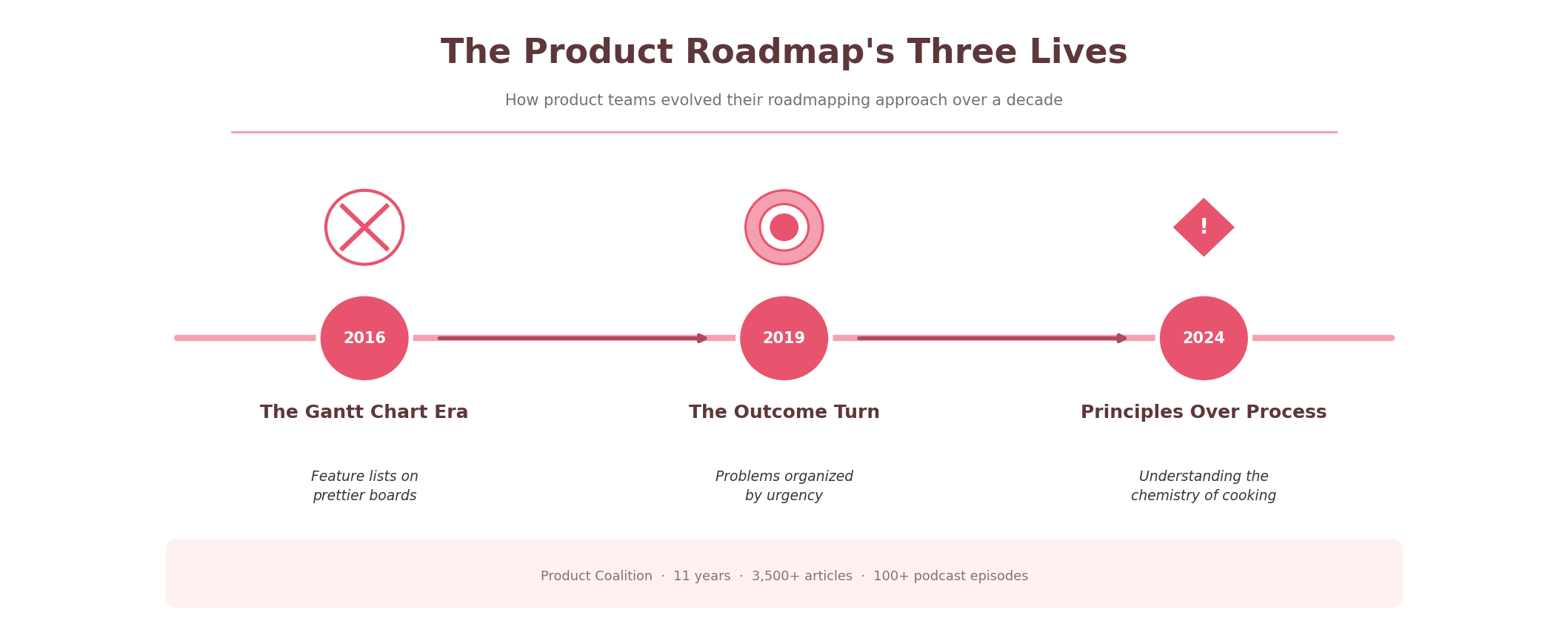
Looking back, this was the era of rebelling against the format without questioning the content. We stopped using Gantt charts. We kept building feature lists. Just on prettier boards.
The Outcome Turn (2019)
By 2019, the conversation had shifted. Elena Sviridenko published ‘Outcome-driven product roadmap‘ on Product Coalition in March of that year, and you could feel the frustration had evolved into something more focused. She started with this observation:
“Many organizations struggle with roadmaps, finding them difficult to maintain and hardly ever coming true.”
That resonated with thousands of readers. But the real gut punch came later in the piece:
“Prioritizing without knowing the context of the problem and the desired outcome is like shooting in the dark.”
Elena introduced the Now/Next/Future framework to our audience. Not features slotted into quarters, but problems organized by urgency. It sounds obvious now. In 2019, it felt radical. I remember the comments section on that article being split between PMs who found it liberating and PMs whose stakeholders would never accept a roadmap without dates.
The outcome-driven movement gave PMs a vocabulary to push back. ‘We’re solving for this outcome’ is a different conversation than ‘we’re shipping this feature in Q3.’ Better conversation, honestly. But it also created a new problem: roadmaps that were so abstract they didn’t actually communicate anything to engineering teams or executives.
Principles Over Process (2023-2024)
This is the part that fascinates me. John Utz published two pieces with us. ‘What is a product roadmap?‘ in May 2023 and ‘Rethinking product roadmaps‘ in November 2024. I think they represent where roadmap thinking has landed. In the earlier piece, he tells a story about pitching features to a stakeholder who stopped him cold:
“You are just sharing features; that’s your release plan.”
Ouch. John went on to frame the roadmap as fundamentally a communication tool, citing Bruce McCarthy’s definition: “A product roadmap is a tool for communication and alignment. It tells the story of where you are, where you are going, and how you will get there. It is not a project plan or a commitment. It is a strategic document.”
Then in late 2024, John came back with a first-principles framework. Eight principles for building roadmaps, rooted in the Elon Musk approach of questioning every assumption. He wrote:
“It’s the difference between following a recipe and understanding the chemistry of cooking.”
I think this captures the maturation perfectly. In 2016, we were arguing about the tool (Gantt chart vs. Trello). In 2019, we were arguing about the content (features vs. outcomes). By 2024, we’re arguing about the thinking underneath. The recipe doesn’t matter if you understand what each ingredient does.
John also admitted something most roadmap evangelists won’t: “We were behind our competition, pumping out features with low value, slow to release, and pandering to our stakeholders, not our customers.” That kind of honesty only shows up when someone has been through the full cycle.
What I’m Hearing on the Podcast
On a recent episode of the Product Coalition podcast, Valentina Coin told me something that reframed how I think about all of this. We were talking about change management and she said: “You have a human being that is grieving the way things were, very comfortable, very familiar. Maybe they took a little bit longer to get done. Maybe it was a little bit inconvenient, but it was familiar.”
She was talking about digital transformation broadly. But I couldn’t stop applying it to roadmaps. Every time we reinvent the roadmap format, teams have to grieve the old one.
The PM who mastered the Gantt chart had to let it go. The PM who perfected the feature-based quarterly roadmap had to learn outcomes thinking. Now we’re asking people to operate on principles. That’s harder. And people resist harder things, at least at first.
(Listen to EP100 with Valentina Coin)
So What Does This Mean for You?
The roadmap didn’t die. It grew up. And here’s what I’d actually take away from watching a decade of this evolution: stop optimizing the artifact and start getting better at the conversation around it. Your roadmap format matters less than whether your team and stakeholders walk away from a roadmap review aligned on what matters and why.
I’d love to hear from you. What does your current roadmap actually look like? Reply to this email and tell me, genuinely curious whether you’re still in the outcome camp or if you’ve moved on to something else entirely.
You’re reading the Product Coalition newsletter. Every week, I dig into the archive of 3,500+ articles and 100+ podcast episodes to trace how product thinking has evolved. If someone forwarded this to you, subscribe here so you don’t miss the next one.
Jay Stansell · Lisbon, Portugal · Product Coalition