


Brought to you by ExecReps.ai, AI-powered executive presence coaching for teams.
👉 If you're not a subscriber yet, subscribe here so you don't miss the next issue.
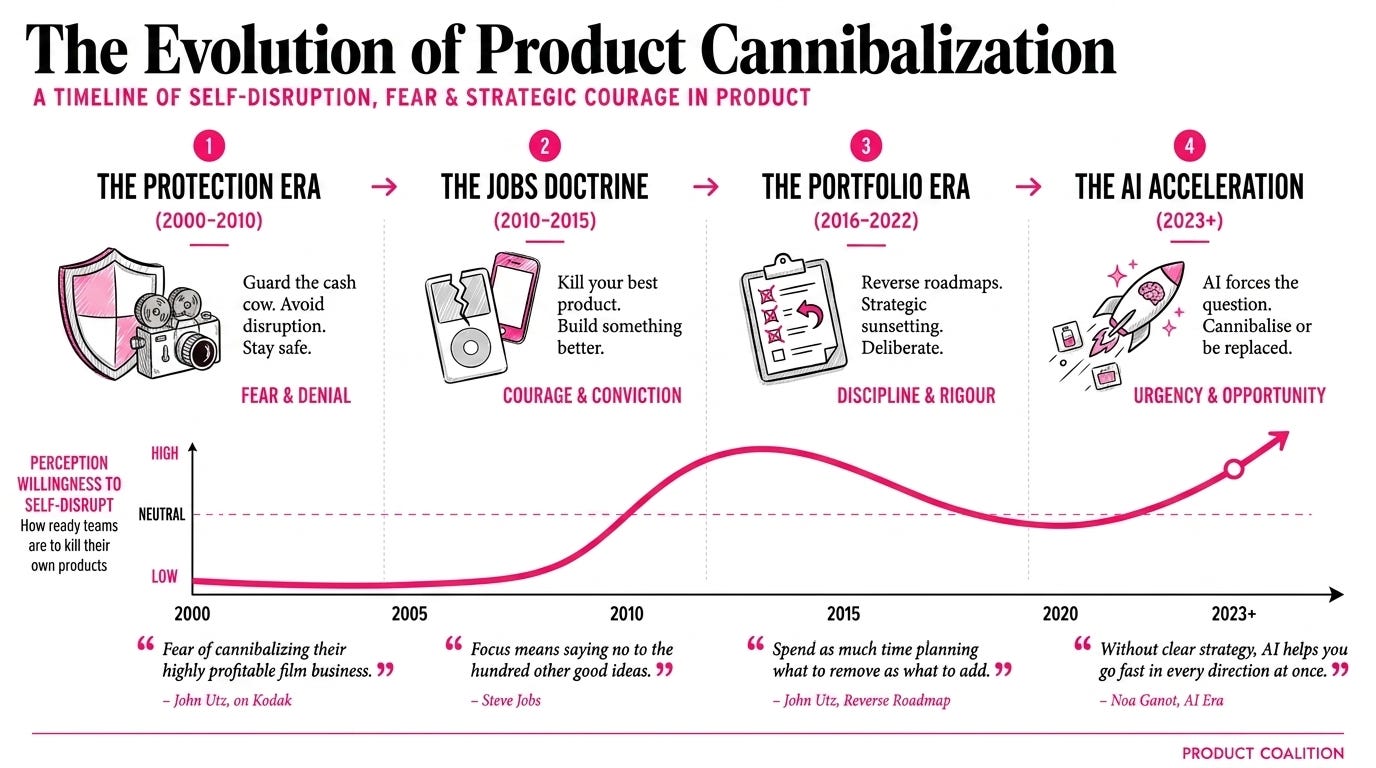
Kodak invented the first digital camera. They held a vast portfolio of digital photography patents. And in 2012, they filed for bankruptcy. The reason? They were too afraid to cannibalize their own film business. Meanwhile, Apple looked at the iPod, its most successful product at the time, and said "let's kill it" by launching the iPhone. Same decade. Opposite instincts. Wildly different outcomes.
This issue's articles hit different because the writers aren't theorizing from the sidelines. John Utz, Gaurav Nukala, and Noa Ganot are in the trenches, wrestling with the exact tension that killed Kodak: when do you protect what's working, and when do you burn it down for something better?
The thing I keep coming back to is how emotional this decision is. It's not a spreadsheet problem. It's a courage problem. John Utz captured Kodak's failure perfectly: "Despite being a pioneer in the photography industry and holding a vast portfolio of digital patents, Kodak failed to prioritize the transition to digital photography effectively. This reluctance stemmed from a fear of cannibalizing their highly profitable film business."
They had the technology. They owned the patents. But the comfort of existing revenue held them hostage.
John continues: "Kodak's hesitation and misaligned priorities led to its inability to capitalize on its technological advancements, ultimately resulting in the company filing for bankruptcy in 2012." That's the quiet tragedy of product cannibalization anxiety. It doesn't look like a crisis at the time. It looks like prudence. It looks like protecting the business. Until it's too late.
Steve Jobs understood this better than most: "People think focus means saying yes to the thing you've got to focus on. But that's not what it means at all. It means saying no to the hundred other good ideas that there are." And sometimes that 'no' is aimed at your own current cash cow.
I wonder if most product teams even have the vocabulary for this conversation. Our roadmaps are full of "new features" and "growth initiatives." I almost never see "product sunsetting" or "feature deletion" as a top priority. John Utz addresses this head-on in Delete to Accelerate: Transforming Your Product with a Reverse Roadmap. He points out something that made me pause: "We have a roadmap that is largely, if not entirely, focused on releasing new stuff while maintaining what we have. But for some reason, we don't have a roadmap focused on decluttering and simplifying the product."
I found myself nodding at that. Launches get celebrated. Retirements get mourned, or worse, avoided entirely.
John describes his own frustration: "I was pissed. So what did I do? This was around the time that the idea of a separate, reverse roadmap came to mind." His proposal is simple and a bit radical: "Spend as much time planning for what you will get rid of as you do planning for what you will add." Adobe, Atlassian, and Salesforce all maintain separate retirement roadmaps. It's not a fringe idea. But it still feels rare in practice.
This isn't about arbitrary deletion though. Gaurav Nukala brings the bigger picture with How To Determine Product Priority: A Portfolio Management Framework. He makes the uncomfortable case that sometimes you have to sacrifice individual product success for the health of the whole portfolio. "We have to sub optimize individual products to optimize the portfolio," he writes. That sounds like a tough conversation to have with the team that just shipped a solid quarter on a product you're about to sunset.
And then there's the AI acceleration. Noa Ganot's Product Strategy in the AI Era hits this point hard. "Without a clear product strategy, AI will help you go fast in every possible direction at once." That line has been rattling around in my head since I read it. Everyone is shipping AI features. But without a strategy for what to keep, what to replace, and what to let go of, you end up with a bloated mess. Noa warns, "You can't afford to do it blindly, spray and pray, and hope that somehow one of your attempts will work."
Jeff Bezos put it another way, as quoted in John Utz's The Power of Product Lifecycle Management: "All businesses need to be young forever. If your customer base ages with you, you're Woolworth's." That's not about ageism. It's about relevance. And staying relevant sometimes means your best product today becomes the thing you retire tomorrow.
What I Am Hearing on the Podcast
This tension between protecting what works and building what's next keeps surfacing in my podcast conversations.
I was talking with Dan Balcauski in EP83 about pricing and packaging when he asked something that stuck with me: "Is this new set of capabilities, the benefits, the use case that we're talking about, is this talking to the same buyer? Is this an extension of that same buyer's life? Or are we talking to the person in the cube next to him or in the building next to him?"
That question matters for cannibalization more than people think. If you're building for the same buyer, you're creating a choice. And if the new thing is better, the old thing has to go. Dan also said something that's hard to hear but important: "The customers don't care about how many story points it took to build your feature and they don't care about the variable costs of your expenses. The value is not in the feature. The value is in the mind of the customer." Internal effort doesn't equal external value. And when the new product delivers more value, sentimentality about the old one becomes a liability.
In EP93 with Nicole Segerer, the conversation got into AI and cloud migration. Nicole shared something sobering: "80% of companies will have launched some sort of AI functionality. But when you really go deeper and you look at, okay, are customers using this? And is it something that carries some value that people would actually pay for? That creates a whole different picture."
She also named the classic cannibalization standoff: "Sometimes the profitability is still sitting with on-premise products. That's okay. But then you also need to think about how do I grab that customer cohort and move them to my cloud and SaaS products." The old product is still paying the bills. The new product is the future. Managing that transition without blowing everything up is one of the hardest things in product.
Nicole finished with something that keeps echoing for me: "People need to unlearn to just build features and capabilities for the sake of it. It doesn't work, especially when you think about AI use cases." Unlearning. That might be the most important skill in product right now. Unlearning the instinct to protect, to add, to preserve. Learning instead to subtract, to sunset, to cannibalize your own work before someone else does it for you.
I keep wondering though. How do you build that muscle? How do you create a culture where killing your own successful product isn't career suicide but career-defining? I don't have a clean answer for that. Maybe nobody does yet.
John Utz, Gaurav Nukala, and Noa Ganot are doing the work that matters here. John isn't just writing about reverse roadmaps as a concept. He lived the frustration, got mad about it, and built the framework. Gaurav is bringing rigour to portfolio decisions that most teams make on gut instinct. And Noa is asking the hard questions about AI strategy that everyone is thinking but few are writing down. These are practitioners sharing what they've learned in the middle of doing it, not from the comfort of having figured it all out. That's what makes their work worth reading.
👋 Jay
Sources: