


I found a box of old notebooks in my garage last week. Index cards with user stories scribbled in pencil, acceptance criteria that read more like legal contracts than promises of value. I remember being proud of those cards. I thought the process was the work. Looking at them now, I see a graveyard of features nobody ever used.
That got me thinking. So I went back through our archive to trace how we went from "let's talk about what the user needs" to "please fill in the Jira template correctly."
Brought to you by ExecReps.ai — AI-powered executive presence coaching for teams.
Product Coalition is a reader-supported publication. To receive new posts and support my work, consider becoming a free or paid subscriber.
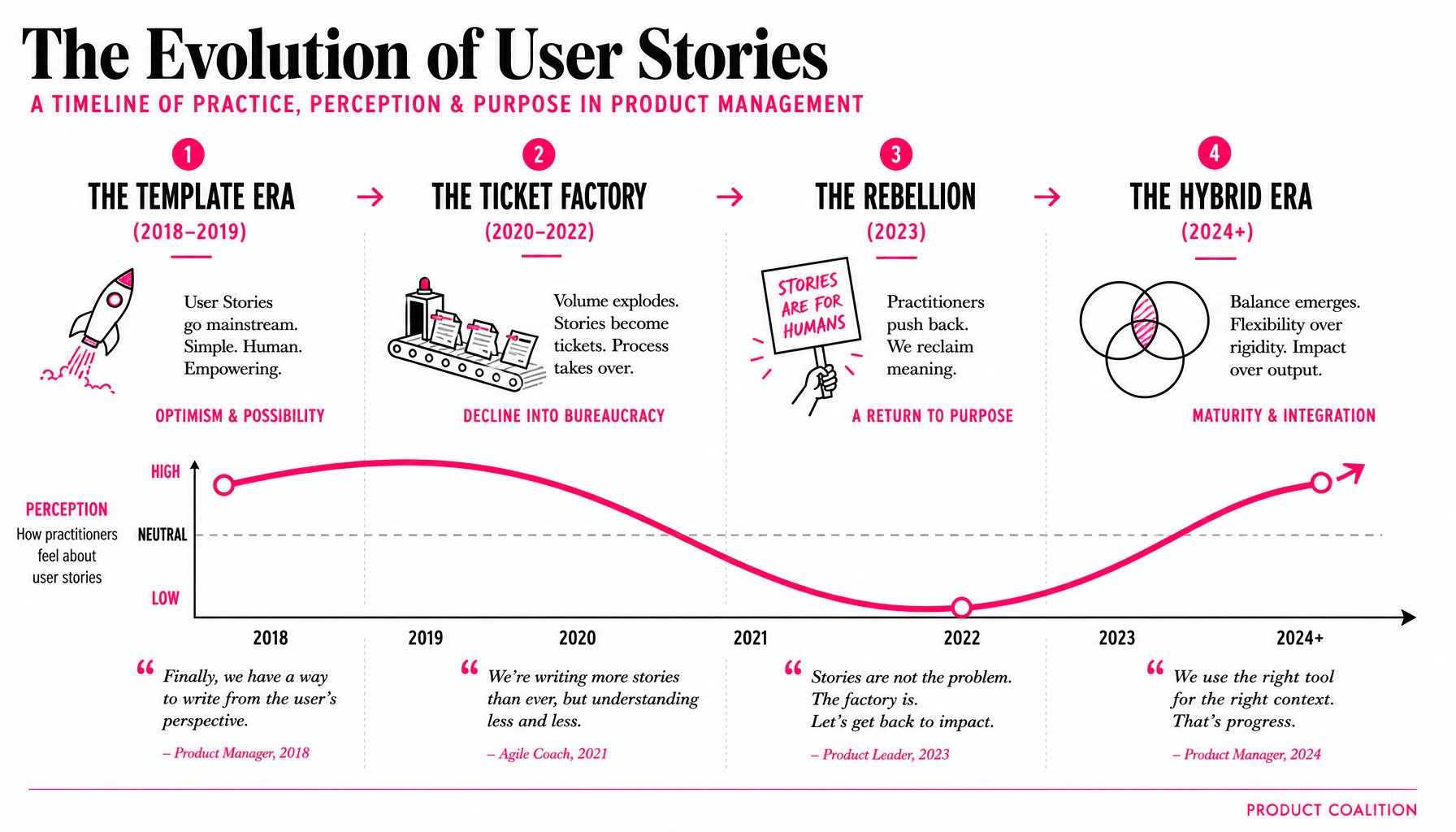
The Template Era (2018–2019)
In 2018, Bindiya Thakkar wrote what might be the most earnest guide to user stories ever published on Product Coalition. She laid out the whole thing: epics with four sections, stories with acceptance criteria, design requirements, engineering requirements. Every piece accounted for, every edge documented.
"Writing a good epic and user story is the most basic and the most important task at hand when you enter the role of Product Management."
I don't say that dismissively. If you were a new PM in 2018, that article was a lifeline. You had no idea what you were doing, and here was someone who'd been in the trenches laying out exactly how to write the thing your team was going to build from. Not a VP giving a keynote. A practitioner, sharing what she'd figured out.
That was the energy of user stories when they still worked. They were conversation starters, not paperwork. Bindiya's article reads like someone who genuinely believed that if you wrote the story well enough, the team would build the right thing. And for a while, that was probably true.
The Ticket Factory (2020–2022)
Then something shifted. The tool became the process. The process became the bureaucracy.
J.A. Becker captured it perfectly in 2022: "I used to slave over these things. They had to be perfect." His manager would review every Jira ticket and make him rewrite it again and again. Some companies were actually reviewing ticket quality for performance evaluations.
Think about that. We took a format designed to start a conversation and turned it into something you could be graded on.
"Perfect tickets are perfectly scoped to do a given task perfectly in a perfect world. And it's not a perfect world."
That same year, John McDonald pointed out that most product teams were building with no real map of where they were going. "Too much focus on getting things shipped and too little focus on the who, what, why and how." His solution was story mapping, which at least tried to reconnect the stories to a bigger picture. But the fact that he had to write that article tells you how far we'd drifted. Teams were cranking through backlogs of perfectly formatted tickets that added up to nothing.
Here is the part nobody on stage at conferences talks about. The PMs writing those tickets were not lazy or incompetent. They were doing exactly what the system asked of them. Write the ticket. Get it estimated. Ship it. Repeat. If the output didn't create outcomes, that was somehow also their fault. The messy middle of product management, the place where most of us actually work, had been reduced to a ticket queue.
The Rebellion (2023)
By 2023, practitioners started saying what they'd been thinking for years.
Lee Fischman published a piece called "A meditation on how user stories can be really stupid." Not the kind of title you'd hear at a product leadership summit. But the kind of thing you'd say to a colleague over coffee.
His point was subtle: the format itself creates tautologies. "As a user, I want X because I want to do X." We'd turned a communication tool into a fill-in-the-blank exercise where the blanks didn't even make sense half the time. His advice? "If its purpose ends up looking silly, maybe try to improve it, or leave it out." Radical honesty from someone in the middle, not the top.
Lisa Mo Wagner took a different angle that same year. She was still teaching the craft, still showing people how to write good stories, but she'd quietly moved to the "job story" format instead. "When [situation], I want to [motivation], so I can [expected outcome]." Notice what changed. The user is in a situation, not a persona. The motivation is real, not a template fill. It was an evolution driven by the people doing the actual work.
And then Ant Murphy dropped the hammer: "Ditch Epics and User Stories and Focus on Outcomes."
Ant had been helping organisations shift from output to outcome thinking, and he kept seeing the same problem. "I've seen too many places get stuck in a perpetual hamster wheel arguing over what an Epic is. Epics vs Initiatives vs User Stories? Who owns what? Who prioritises what? Where do they belong?" All that energy wasted on semantics while nobody was measuring whether the work actually changed anything.
His reframe hit hard: going from "I want" to "we believe" shifts from certainty to uncertainty. "We believe" admits you might be wrong. "I want" pretends you already know.
What Replaced Them?
I am not sure anything cleanly replaced user stories. The best teams I talk to have moved toward a hybrid that looks less like a template and more like a thinking tool.
Ram Maganti wrote about the synergy between problem statements and user stories on Product Coalition: "Failure to thoroughly understand these pain points can increase the risk of product failure." He argued that user stories work when they're paired with problem statements that provide the context. Without the problem, the story is just a task.
Lavaneesh Gautam pushed for smaller, more valuable backlog items. "A product is a vehicle designed to deliver value and each Product Backlog Item should deliver incremental value." His warning is one I've ignored too many times: "Many teams sometimes break down units of value into tasks and consider them as product backlog items, please don't do this." When you do, you end up managing a list of chores instead of a product.
And Noa Ganot flipped the whole customer request problem on its head: "The product manager doesn't need to be the voice of the customer. That's on sales and customer success. Instead, the product manager needs to be the voice of the market." She gave PMs permission to let customer requests sit in the backlog, reframing them as "a treasure trove of raw market signals" rather than orders at a restaurant.
None of these people are CEOs of billion-dollar companies. They are practitioners sharing hard-won lessons from the middle of the work. That is exactly why it matters.
What I Am Hearing on the Podcast
Back in 2020, I sat down with James Sear and Tim Ramage from Avion in a WeWork in Holborn to talk about user story mapping. They built a digital story mapping tool because they kept seeing the same problem: teams would do the hard work of mapping everything out on a wall, have brilliant conversations, and then dump it all into a backlog tool and forget the map ever existed.
James put it plainly: "You have really great conversations. You get everyone involved, and then you put everything into a backlog tool manually, and you forget about the user story map. And all of that context and conversation that you had is lost."
That loss of context is the thread running through everything I've traced in this issue. The format was never the point. The conversation was the point. And the conversation got lost somewhere between the Post-it wall and the Jira board.
Tim made a distinction that has stuck with me: "It's less about what's our velocity and how many points can we deliver in the next sprint, and it's more about what's our hypothesis here. Let's create a release around what we think we want to solve." That shift, from velocity to hypothesis, is exactly what Ant Murphy and the 2023 practitioners were pushing toward. The podcast conversation in 2020 was already pointing where the written discourse would land three years later.
One detail that made me laugh: Tim said the biggest pitfall with physical story mapping is that "they fall off the wall after you've moved them at least twice, or the cleaners come in." Coming into the room and seeing five Post-it notes on the floor with no idea where they belonged. If you've ever been on a product team, you've lived that moment. Nobody puts that in a conference keynote, but everyone in the messy middle knows exactly what it means.
Listen to the full conversation
So Where Does That Leave Us?
User stories did not fail because the format was bad. They failed because we stopped using them as conversation starters and started using them as compliance documents. The original idea, a placeholder for a human conversation about what we're building and why, was always sound. We just buried it under process.
The people I've quoted in this piece are not famous. They are product managers, product coaches, and practitioners who sat down and wrote about what they were seeing in their own teams. That's what Product Coalition exists for. Not to tell you what the top of the industry thinks, but to give you access to what your peers have figured out.
If you stopped using the standard user story format tomorrow, what would you replace it with to make sure your team still builds the right thing? Hit reply and tell me. I want to hear what's working in your world, not just what the textbooks say should work.
You're reading the Product Coalition newsletter. Every week, I dig into the archive of 3,500+ articles and 100+ podcast episodes to trace how product thinking has evolved. If someone forwarded this to you, subscribe here so you don't miss the next one.
👋 Jay
Sources
Bindiya Thakkar — How to Write Epics and User Stories (Nov 2018), J.A. Becker — Writing the Perfect Jira Ticket Doesn't Matter (Mar 2022), John McDonald — Why Product Managers Should Be Story Mapping (Jun 2022), Lee Fischman — A meditation on how user stories can be really stupid (Oct 2023), Lisa Mo Wagner — How to Write the Best User Stories (Jul 2023), Ant Murphy — Ditch Epics and User Stories and Focus on Outcomes (Jul 2023), Ram Maganti — It's About Synergy: The Power of Problem Statements and User Stories, Lavaneesh Gautam — How To Create Small Product Backlog Items, Noa Ganot — Building Trust Around Customer Requests