


I’ve been digging through our archive of MVP articles this week, and the emotional arc is wilder than I expected. In 2015, our contributors were practically begging people to just ship something, anything. By 2020, the tone shifted to ‘ship, but please make it good.’ And now, in 2025, someone wrote a whole piece declaring the MVP dead. Ten years. Same community. Completely different advice.
Brought to you by ExecReps, AI coaching that helps product leaders practice the conversations that matter most
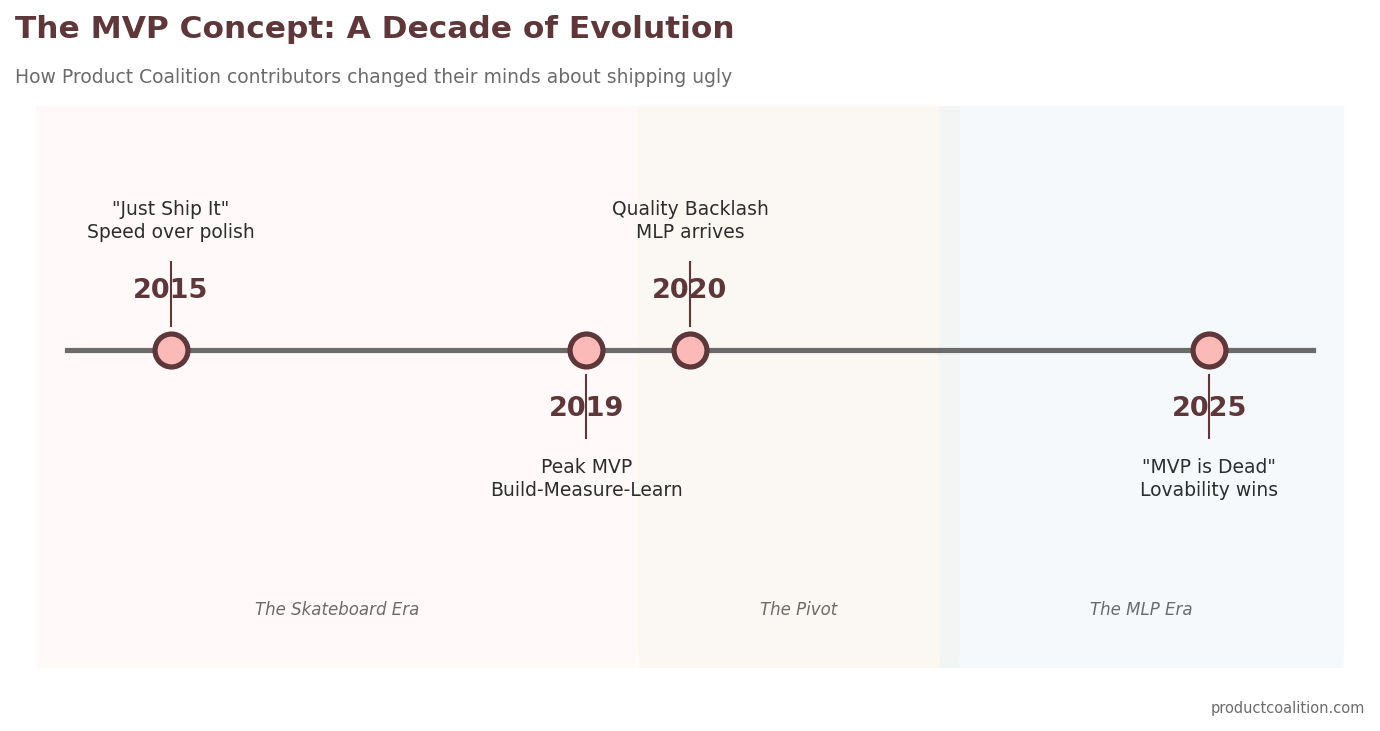
Just Ship Something, Please (2015–2019)
In December 2015, Fabrice Wegner wrote ‘The Vicious Circle of Preparation’ for Product Coalition, and reading it now feels like stepping into a time capsule. Fabrice was watching teams get stuck in endless preparation loops. Stakeholders would prioritize half-baked epics, product owners would scramble to validate them, engineers would wait around, and nobody shipped anything. His frustrated question cut through the noise:
“Is it wrong to want ship fast?”
The answer back then was a loud no. Speed was the gospel. Fabrice also dropped a line that I think most MVP evangelists never fully internalized: “Your customers won’t get happier or pay you a dollar if your team has learnt something. But the learning increment is the basis of a successful product.” Learning was supposed to justify shipping ugly. The trouble was, a lot of teams took that permission and ran with it.
Four years later, Vaibhav Gupta published ‘How to Define MVP’ on Product Coalition as part of a Product Management 101 series. His framing was textbook Lean Startup: “It is the smallest thing that you can build that would deliver some value to your customers and also help you gather validated learning about customers with least effort.” He walked through the Uber example (Travis Kalanick driving a car, a basic web app for hailing it), the skateboard-to-car analogy, the Build-Measure-Learn loop. All the hits.
This was still peak MVP optimism. The assumption was clear: build the smallest useful version and the path forward reveals itself. What nobody was really asking yet was whether the smallest useful version might also be the version users hate.
Ship Fast, But Please Make It Good (2020)
OK so here’s where it gets interesting. I pulled up two articles from 2020 and they basically argue with each other without meaning to.
In March of that year, Yellow Systems wrote ‘An MVP Can Save Your Product’s Life’ and was still firmly in the pro-MVP camp. Their argument: “launch delays have killed millions of startups and will probably kill millions more.” Fair enough. Ship now. Worry later. But then they snuck in a line that stopped me: a reduction in features is expected, they wrote, but “there should be no reduction in quality.”
Wait. Quality? In an MVP? I had to reread that. The whole MVP playbook, at least how most teams ran it, was basically trading quality for speed. Yellow was drawing a line nobody had drawn before. Strip the features, sure. But the stuff you keep? It better work. And it better look like someone cared.
Then Carlos Gonzalez de Villaumbrosia dropped ‘What Is a Minimum Lovable Product?’ that same summer and I remember reading his opening line twice. He basically said: meeting needs isn’t enough. Your users want to be delighted. They don’t want to tolerate your product. They want to love the thing.
I keep coming back to his next line: “being Viable just doesn’t cut it anymore. You need to be Lovable.” Carlos wasn’t really killing the MVP. He was renaming it, adding a higher bar. The MLP, he explained, is like an MVP “but with more thought and care taken in design and UI.”
And honestly? He was right about the timing. By 2020, users had lived with Slack and Notion and Figma. Their baseline for ‘acceptable first version’ was miles above where it sat in 2015. The floor had moved and a lot of teams hadn’t noticed.
RIP MVP? (2025)
This is where the backlash got loud. Garima Srivastava, one of our contributors, wrote a piece titled ‘Minimum Viable Product (MVP) is Dead’ earlier this year and she pulled zero punches. The MVP, she wrote, was supposed to get you early feedback. What it actually does? It produces “half-baked products that nobody loves.”
Garima’s analogy is the kind that stays with you. She compared most MVPs to someone serving you an uncooked pizza and telling you to imagine how great it’ll be once it’s done. Nobody wants that. Nobody shares that with friends. Her point: viability isn’t the bar anymore. Loveability is. People don’t recommend products they merely tolerate.
I’m not sure I fully agree. The original MVP concept, the one Eric Ries actually described, was never supposed to be a product you ship to the market and walk away from. It was a learning tool. But the PM community took ‘minimum viable’ and heard ‘minimum effort,’ and that misreading created a decade of products that launched to crickets.
The correction isn’t wrong. It’s just late. And honestly, I wonder if MLP will get misread the same way in another five years.
What I’m Hearing on the Podcast
Raksha Vashishta joined us on the podcast for an episode she called ‘The MVP of My Career.’ She talked about her journey as an immigrant woman in tech, applying MVP thinking not just to products but to her own career path. Start small. Validate. Pivot when the data says to. Her story of building from an accounts receivable internship to a product leadership role mirrors the MVP-to-MLP arc in a way I wasn’t expecting: the first version of your career doesn’t need to be polished. But at some point, you stop iterating on the minimum and start building something you’re genuinely proud of.
So What Does This Mean for You?
The MVP isn’t dead. But the era of shipping something ugly and calling it strategy? That part is over. What actually changed isn’t the framework itself. It’s the floor. User expectations in 2025 are so far above where they were in 2015 that the ‘minimum’ in ‘minimum viable’ now means something completely different.
When was the last time you shipped a true MVP, the ugliest working version you could get away with, and actually got useful feedback from it? Or has your team already moved past that into MLP territory without calling it that? Reply and tell me. I genuinely want to know if the skateboard still works.
You’re reading the Product Coalition newsletter. Every week, I dig into the archive of 3,500+ articles and 100+ podcast episodes to trace how product thinking has evolved. If someone forwarded this to you, subscribe here so you don’t miss the next one.
Jay Stansell · Lisbon, Portugal · Product Coalition