


Brought to you by ExecReps - AI coaching that helps product leaders practice the conversations that matter most
I keep hearing the same pitch: “We replaced three FTEs with an agent workflow.”
Cool. But who owns the budget line when that agent hallucinates a contract clause? Who absorbs the cost when your inference bill triples because a customer’s edge case sent your agent into a retry loop? And when you show up to quarterly review, is that agent spend capex or opex?
These are the conversations happening in every finance review I hear about right now. And most product leaders are walking in unprepared.
The 95% problem is a money problem
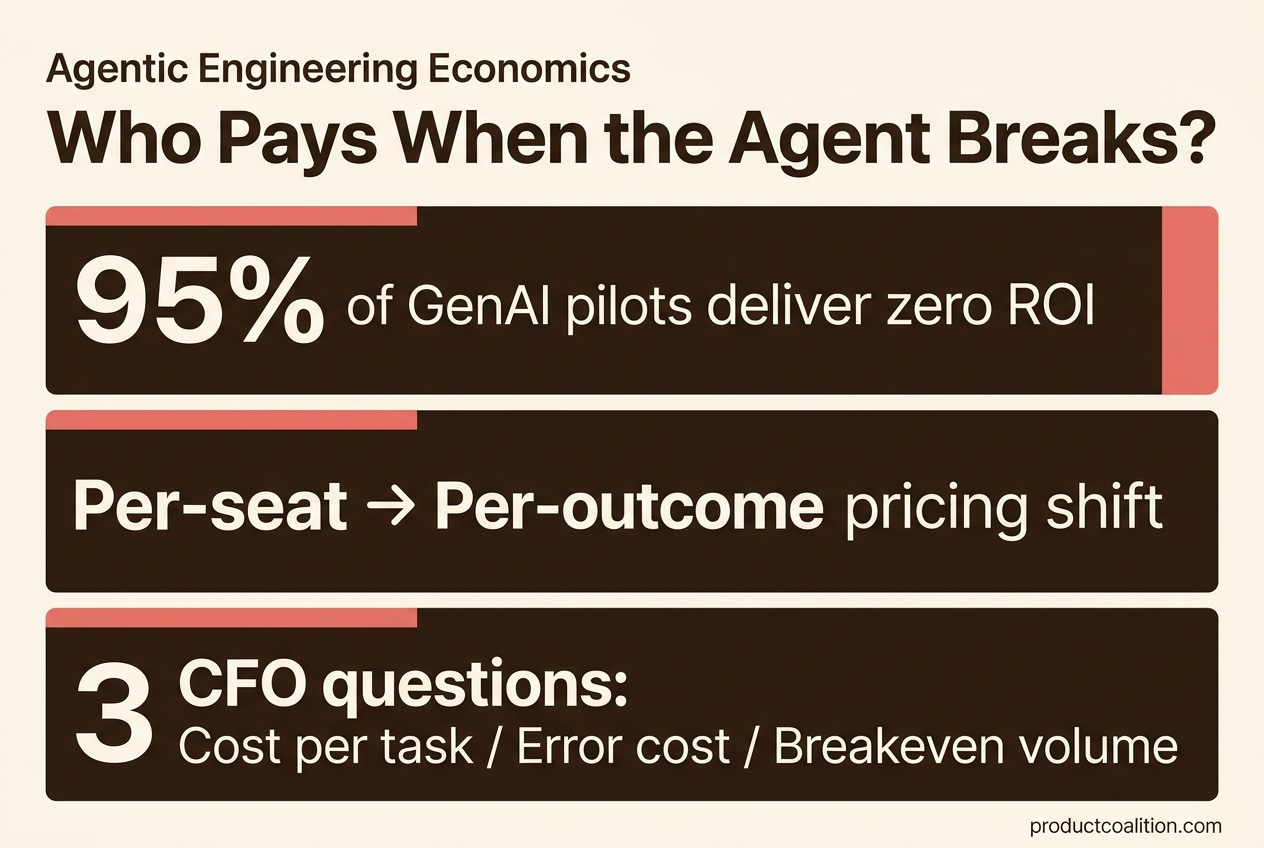
Here’s a number that should keep every CPO up at night: 95% of GenAI pilots deliver zero return on investment. Bulbul Pandya put it bluntly in Product Coalition last year: “AI doesn’t absolve us from doing the product work. It magnifies the consequences of skipping it.”
That’s not a technology problem. That’s a commercial discipline problem. Teams are shipping agent features without a unit economics model. No cost-per-task target. No margin threshold. No kill switch when the math stops working. And CFOs are starting to notice.
The cost of inference dropped 99% in two years. Sounds like a gift, right? It is, until you realise that cheaper tokens mean teams use 100x more of them. I’ve talked to product orgs where their monthly AI compute bill went from a rounding error to their third-largest line item in under a year. When nobody owns the P&L for agent spend, nobody notices until the quarterly close.
Per-seat is dead. Per-outcome is terrifying.
Serhat Pala wrote something in Product Coalition this week that crystallised what I’ve been thinking. He called it SaaS 2.0: “SaaS 1.0 charged per seat. Customers paid for access. SaaS 2.0 charges per outcome. Customers pay for work completed. A support ticket resolved. A tax return filed. A contract reviewed.”
That sounds clean on a slide. In practice, it flips the entire risk model. When you charge per outcome, your margin depends on how efficiently the agent delivers. If the agent needs human intervention 20% of the time, your gross margin might be 60%. If it needs help 40% of the time, you’re running a service business with software pricing. And good luck explaining that variance to your board.
This is the part most product leaders haven’t internalised yet. Per-seat pricing meant predictable revenue regardless of whether the customer got value. Per-outcome pricing means you eat the cost of every failure. Your agent’s accuracy rate isn’t just a product metric anymore. It’s a margin metric.
The three questions your CFO will ask (and you’d better have answers)
I’ve been collecting the questions that finance teams are actually asking product leaders about agent spend. Three keep coming up:
First: “What’s the fully loaded cost per agent-completed task, including compute, orchestration, evaluation, and human escalation?” If you can’t answer this, you don’t have a business case. You have a demo.
Second: “What’s the error rate, and what does each error cost us?” Jon Matheson learned the hard way that product managers who don’t understand how their decisions affect revenue, COGS, and margin are doing half the job. With agents, the stakes are higher because the cost of a wrong output isn’t just a bug ticket. It can be a compliance event.
Third: “At what volume does this become cheaper than the alternative?” Not cheaper than the old software. Cheaper than the humans, contractors, or BPO teams doing the same work today. Thomas Schwenger described it perfectly: “The translation layer between business ideas and working software has been the most expensive bottleneck in technology for decades. It is collapsing.” True. But collapsing doesn’t mean free. It means the cost moved from headcount to infrastructure. Your CFO wants to know exactly where it landed.
The product leaders who thrive in this era won’t be the ones who ship the most agents. They’ll be the ones who can show the unit economics on a single slide and defend every number on it.
What’s the hardest financial question your CFO or board has asked you about AI agent spending - and did you have an answer? Hit reply. I want to hear the real stories.