


It was 2 am in Lisbon, and I was staring at a spreadsheet of beta user feedback. One response just stopped me cold.
The user, a senior PM at a mid-size SaaS company, had scored well on our platform. Her content was structured, her arguments logical, her delivery measured. By every objective metric we’d built, she was a strong communicator.
Her feedback, though, said: “I guess I’m just not a natural speaker. My scores are fine but I still don’t feel like I know what I’m doing.”
Fine scores. No identity.
That’s when I realized we’d built a measuring stick when people wanted a mirror. The thing I kept coming back to was this idea of identity.
The Score Trap
Let me rewind. By November 2025, ExecReps had acoustic voice analysis working. V1.0 shipped with AssemblyAI-powered analysis of pace, filler words, clarity, confidence.
Users would record a practice response to a scenario like ‘Your CEO just asked you to explain why the roadmap is slipping, go,’ and we’d break down both content quality and vocal delivery.
The scores were… fine. People used them. People improved. Something, though, was missing.
I’m not sure if it was the numbers themselves, or just how we were presenting them. I wonder if it’s just human nature to want more than a number.
I kept hearing the same questions: “What’s a good score?” “Am I normal?” “How do I compare?”
These aren’t questions about improvement. These are questions about identity. People weren’t asking “How do I get better?” They were asking “Who am I as a communicator?”
Anyone who’s read Deci and Ryan’s Self-Determination Theory would recognize the pattern. Scores satisfy competence (one of three basic psychological needs) but completely miss relatedness and autonomy.
A number tells you where you rank. It doesn’t tell you where you belong.
I’d spent fifteen years building products and somehow missed one of the most documented insights in motivation research. People don’t optimize for numbers. They optimize for a sense of self.
This reminds me of a conversation I had with a founder recently, talking about how a lot of fitness apps fail because they focus on calories burned, not on the feeling of being an ‘athlete.’ It’s the same thing.
The Research Rabbit Hole
Once I saw the problem, I couldn’t unsee it. So I did what any product person does when they sense an insight. I went deep into the research.
I started with the usual suspects. Big Five (OCEAN) is scientifically validated, but measures who you are, not how you communicate. DISC is closer, but too static. Myers-Briggs has too much pseudoscience baggage. Sixteen types is a nightmare for product design.
None of these were designed for voice. They were built for survey responses and check boxes.
We had actual recordings of people speaking under pressure, with measurable acoustic properties. So we built our own.
Four dimensions emerged:
Command. How much authority and conviction comes through. Not volume. Certainty. Vocal steadiness, declarative phrasing, pacing that says ‘I know what I’m talking about.’
Eloquence. The precision of expression. Vocabulary range, sentence structure, the ability to find exactly the right word instead of four approximate ones.
Engagement. How much you pull people in. Vocal variety, storytelling instincts, tonal warmth. The difference between reading a report and making someone lean forward.
Consistency. How stable your communication is across contexts. Some people are brilliant in a 1:1 and fall apart in front of a group. This dimension measures the gap.
We called it the Voice Performance Score, VPS. We scaled it 400 to 1000, like the SATs.
That familiar-scale choice comes straight from Nielsen’s Recognition over Recall heuristic. If your scoring system requires a user manual, you’ve already lost. The SAT scale gave people an instant mental model. No learning curve.
The VPS wasn’t the breakthrough, however. The archetypes were.
Eight Ways to Speak
What I saw at a company in education (as well as at “MyersBriggs”, “Working Genius” etc ), was this: when you give someone a category to belong to, they engage differently with your product.
At FYG we profiled students into career pathways. The moment a student could say ‘I’m a Builder’ or ‘I’m an Advocate,’ their engagement doubled. Not because the content changed. Because their relationship with the content changed.
If you know the Kano Model, this is the difference between a ‘must-be’ feature and a ‘delighter.’ Scores are must-be. You expect them in an analysis tool. Archetypes are a delighter.
Nobody asked for them. Once people had them, though, they became the reason people came back. Kano’s insight is that delighters create disproportionate satisfaction precisely because they’re unexpected.
So we mapped the four VPS dimensions into eight communication archetypes:
The Analyst. Clarity is their superpower. Blind spot: clarity without engagement can feel cold.
The Commander. Walks into a room and people listen. Not loud, but certain. Blind spot: steamrolling without realizing it.
The Diplomat. Reads the room better than anyone. Builds consensus. Blind spot: prioritizing harmony over directness.
The Maverick. Brilliant in bursts. The off-the-cuff comment everyone remembers. Blind spot: inconsistency.
The Mentor. Natural teachers who make complex things simple. Blind spot: over-explaining when the room just needs a decision.
The Practitioner. Reliable, trusted, steady. Won’t dazzle you, but will never let you down. Blind spot: disappearing in Commander-dominated rooms.
The Storyteller. Turns data into narrative, problems into quests. Blind spot: not every moment needs a story.
The Visionary. The full package when they’re on. Paints futures people run toward. Blind spot: so compelling nobody challenges them.

Choosing eight was a deliberate product decision. Four would have been too broad. People wouldn’t see themselves. Sixteen too granular. Too many edge cases where users fall between types.
This is what Don Norman calls building the right conceptual model: if the model is too simple, people distrust it. If it’s too complex, they can’t hold it in their heads. Eight sits in the cognitive sweet spot. I still wonder if there’s a ‘perfect’ number, but eight just felt right, you know?
We debated whether archetypes should be fixed or fluid. Fixed archetypes are easier to build product around. Fluid archetypes are more scientifically honest. Your style does shift based on context.
We chose a middle path. Your archetype is your dominant style based on your body of work. We surface how your dimensional scores shift across scenarios.
So you might be a Diplomat overall, but skew Commander during board presentation practice. That nuance maps to Daniel Pink’s Autonomy principle from Drive. It gives users freedom to explore their communication range rather than boxing them in. The dominant archetype gives you identity. The dimensional shifts give you agency.
The LinkedIn Moment
We shipped archetypes on November 16th. Within the first week, something happened that I did not expect.
People started sharing their archetype on LinkedIn. Not their score. Not their improvement percentage. Their archetype.
“Just found out I’m a Storyteller on ExecReps. Honestly tracks 😂”
“Apparently I’m a Commander. My team is not surprised.”
“Diplomat here. Which explains why I spend half my life translating between engineering and sales.”
The product insight that hit me then, and that I hope lands for you too, is this: people share identity, not metrics.
Nobody posts their credit score on LinkedIn. Nobody shares their Duolingo XP. They’ll share their Hogwarts house, their Enneagram number, and now, their communication archetype.
Through the lens of Nir Eyal’s Hook Model, we’d accidentally built a complete engagement loop: someone sees an archetype post on LinkedIn (external trigger). Curiosity drives them to try ExecReps (action). They discover their archetype, any of eight possibilities (variable reward, the ‘Hunt’ type). They share it publicly, loading the next trigger for their network while creating a public identity commitment (investment).
We hadn’t designed this loop. Every piece was there, though. I wonder if we could have planned it, or if some of the best product moments just emerge like this, almost by accident.
And what made it powerful rather than gimmicky: the archetypes were grounded in real behavioral data. This wasn’t a quiz telling you what you already knew. It was acoustic analysis of how you speak under pressure.
Cialdini’s Authority principle explains why it stuck: the archetype carries weight because the source is rigorous. A personality quiz calling you creative is forgettable. A voice analysis confirming it is not.
The Diplomat Problem
The title of this post is about Diplomats, and I want to get specific.
When archetype results started rolling in, something interesting emerged. Diplomats were disproportionately likely to have previously described themselves as “bad communicators” in their onboarding surveys.
Read that again. The people most skilled at reading rooms, building consensus, and managing complex interpersonal dynamics… thought they were bad at communication.
Why? Because in most professional environments, ‘good communicator’ is coded as ‘Commander.’ Be decisive, be loud, be certain.
If your natural style is diplomatic. If you listen before speaking, build bridges instead of podiums, choose precision over volume, you’ve been told your whole career to “speak up more.”
Kahneman and Tversky’s work on framing effects explains this precisely. The professional world framed ‘communication skill’ around a single archetype, and Diplomats measure the gap between their style and the dominant one. They interpret that gap as deficiency. It’s a framing problem masquerading as a skill problem.
This hit close to home. I still remember being told my Cockney accent, my natural speaking voice, disqualified me from a design job early in my career. The implicit message then was ‘the way you communicate doesn’t belong here.’ It wasn’t about the content of what I said, but the sound of it. It was about identity, about belonging.
That’s the same message every Diplomat gets in a Commander-dominated culture. Every Mentor told they’re ‘too soft.’ Every Analyst told they’re ‘too in the weeds.’
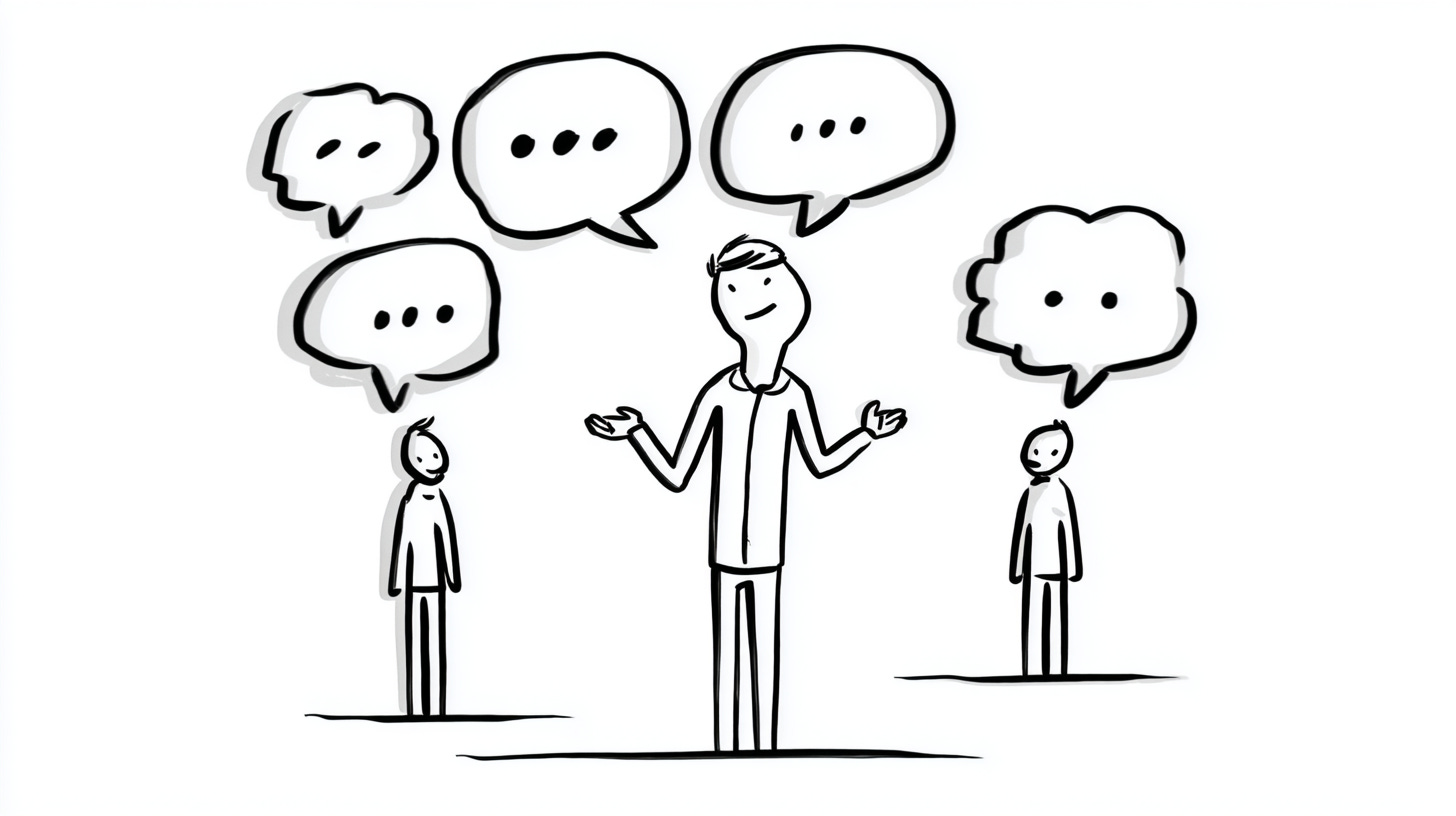
The archetypes reframed what ‘good communication’ even means. There isn’t one model. There are at least eight.
Personas As Product
This is the product lesson I keep thinking about, because I believe it’s underappreciated:
Personas aren’t just a marketing tool. They can be the product itself.
What if the persona isn’t something you build about the user, it’s something you build for them?
Spotify Wrapped understood this. ‘I’m a top 1% listener of Japanese city pop’ is more powerful than any feature Spotify has ever shipped.
When we built archetypes into ExecReps, three things changed, and they map to frameworks any product team would recognize.
Retention jumped. Self-Determination Theory explains why: an identity satisfies all three psychological needs at once, competence (‘I’m a strong Diplomat’), autonomy (‘I choose to develop my style’), relatedness (‘I belong to the Diplomat tribe’). That’s Pink’s Mastery drive, visible progress along a path you’ve claimed as your own.
The product got easier to build. Archetypes gave us a design language. ‘You’re becoming a more commanding Diplomat’ is infinitely more motivating than ‘Your Command score increased by 40 points.’ Norman’s conceptual model principle: when the mental model is rich and intuitive, every communication taps into it.
Word of mouth ignited. BJ Fogg’s B=MAP model explains the mechanics: Motivation was sky-high (identity validation), Ability was trivial (screenshot and post), and the Prompt was the archetype reveal itself. All three maxed at the moment of discovery. We’d accidentally engineered sharing behavior at the exact point where Fogg’s equation was maximally favorable.
Two weeks later we shipped v1.3, the Executive Performance Score. Technically more sophisticated. Content weighted at 60%, delivery at 40%. Population-normalized. Objectively better.
Nobody shared their EPS on LinkedIn. They shared their archetype.
What I’d Tell Myself
If I could go back to early November 2025, deep in acoustic analysis, obsessing over signal processing, I’d tell myself: the most important feature you’re about to ship isn’t the most complex one. It’s the one that helps someone say ‘Oh, that’s who I am.’
Because the biggest barrier isn’t skill. It’s self-knowledge. Most people aren’t bad communicators. They’re communicating in environments that reward a style that isn’t theirs, and they’ve internalized that mismatch as a personal failing.
You’re not a bad communicator. You might just be a Diplomat in a room full of Commanders.
Once you know that, once you see it, you stop trying to be something you’re not, and start figuring out how to be the best version of what you already are.
This idea, this reframing, is at the core of what we’re trying to build with ExecReps. It’s about helping people find their voice, not just change it. I’m still learning how to articulate this, but it feels important.